
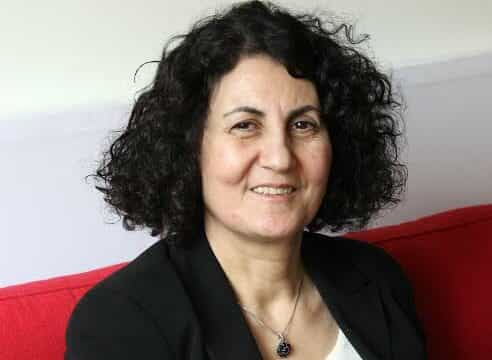
In response to the question of how to prepare women to participate in decision-making, Rawan Modin first challenges the very question: According to her, many women already possess the necessary knowledge, experience, and ability today. The issue is not just education and increasing their confidence; it is also important to see what structures have paved the way for their participation. This perspective is repeated throughout the conversation with her: Women’s empowerment only leads to change when it is accompanied by the removal of legal, economic, and political barriers.
The presenter introduces herself as an educational psychologist, sociologist, researcher, and women’s rights activist, and talks about more than forty-five years of work in this field. In her responses, the discussion of equality is intertwined with specific experiences: resistance to being forced to wear a headscarf while teaching at university, the establishment of a cooperative and vocational fund for women’s economic independence, and documenting sexual and gender violence, especially the so-called «nameousi» murders. In her narrative, research and activism are not separate paths; one helps to understand the mechanisms of discrimination, while the other seeks to transform this understanding into an opportunity for change.
In this conversation, we begin with personal backgrounds and the costs of activism, and we move on to questions about women’s education, economic independence, technology, and political participation. We ask her about discrimination in the workplace, women’s role in decision-making, the experience of failure, and motivation to continue; we also ask about the responsibility of institutions and laws that cannot be left solely on women’s shoulders to change them.
In the following section, you can read Razvan Modim’s interview with «One Thousand and One Women» in five parts; from personal experiences and social obstacles to ways of creating common opportunities for equality.
Part 1 | Introduction and personal background
1. Please introduce yourself; what is your name, field of activity, and your key experiences?
My name is Razzanapour Moghadam; I am a developmental psychologist, sociologist, researcher, and a women’s rights activist. I have been active in various fields of women’s rights for over forty-five years: research on domestic violence and gender discrimination, efforts for equal rights, grassroots initiatives to eliminate discrimination against women, support for women’s civil and protest movements, combating forced hijab and discriminatory laws, and supporting demand-oriented and democratic movements in Iran. A significant part of my work has been documenting sexual and gender-based violence, especially the so-called «namehosi» killings, and turning these documents into tools for awareness-raising and collective action.
2. What factors have played a role in shaping your professional and personal path?
My professional and personal path took shape from several sources: my life experiences, my university education, and my deep belief in social justice. Living in a society with patriarchal structures and discriminatory laws made me sensitive to women’s issues at a young age. Observing gender violence and legal inequalities gave me a strong motivation to become a women’s rights activist.
Political pressure and social constraints not only did not weaken my will, but rather made me more determined to bring women’s voices to voice, to document and expose the systematic violence against them. For me, research and activism are not two separate paths: research helps me see the mechanisms of discrimination more clearly, and activism allows the findings to have an impact in real life.
3. As a woman, what challenges have you faced in your professional career?
As a woman, a women’s rights activist, and a political woman, I have faced numerous challenges. Due to my critical positions and my activism against sexual and gender-based violence and legal inequalities, I have faced security threats and severe restrictions. In academic and university environments, research on women’s rights and gender inequality is often met with resistance from conservative institutions.
Detention, harassment, and being denied teaching have been part of this pressure; these are issues that have been mentioned in reports by the Human Rights Commission. International Amnesty و Scholars at Risk They have also been documented. Being exiled and prevented from working within Iran has been one of the biggest challenges of my life, and I have been forced to continue my work outside the country.
4. Did you have any specific patterns along the way that inspired you?
In the beginning, my activities were spontaneous and I did not start from a specific theoretical framework. My first models were within my family: my grandmother and my mother’s aunt, and other strong women who were not lacking in the family. My grandmother had lost her husband at the age of 30, but without having a man to manage her life, she was able to create work for herself and several other women. Her strength was a living lesson for me.
Later, Judith Butler inspired me; an intellectual whose theories about gender and power have helped to shape new discourses in feminist studies and sociology.
5. If you wanted to introduce yourself in one sentence, what would that sentence be?
The question is difficult; but if I were to say casually: «Researcher and women’s rights activist; influential in the fight against violence against women, especially honor killings in Iran and the Middle East.» I feel good about having contributed to creating positive changes.
Part Two | Challenges faced by women in Iran and around the world
6. What are the biggest obstacles and limitations faced by women in Iran?
The obstacles facing women in Iran are so extensive that they are known as the «Seven Hundred Pages of Paper.» These obstacles have their roots in legal, social, economic, and political spheres and are fueled by a patriarchal structure, discriminatory laws, and state repression.
Discriminatory laws and the lack of effective legal protection place women in an unequal position within the family and society. Educational and occupational restrictions, including gender quotas in universities and certain disciplines, limit women’s access to certain academic fields. Discrimination in employment, wage gaps, and a lack of equal opportunities for career advancement make women’s economic independence difficult. «The »glass ceiling” keeps women away from many management and decision-making positions.
Controlling women’s appearance and behavior, especially Compulsory hijab and its regulatory mechanismsIt is a psychological and permanent pressure. Patrols and other governmental institutions limit women’s freedom in the workplace, public spaces, and even private spheres.
Structural and domestic violence reproduce themselves in the absence of a comprehensive law and effective implementation. Human Rights Watch’s 2025 report on Iran It also emphasizes the lack of a comprehensive legal framework to prevent domestic violence and support survivors.
7. How have you dealt with gender discrimination, social stereotypes, and legal barriers?
I have used the combination of academic activity, research, and social activism. I have sought to redefine the role of women in society and show that women are not just victims of discrimination; they are active forces for social and political change.
I have critiqued patriarchal narratives and challenged gender stereotypes in everyday speech and behavior. With my articles, interviews, speeches, and workshops, I have sought to raise public awareness about discrimination and its consequences. In addition, I have considered the importance of establishing a link between the Iranian feminist movement and international networks to exchange experiences and effective solutions to combat discrimination.
8. Have you encountered gender inequality in the workplace or in society? How did you deal with it?
Abundant. Which woman have you known who has lived in an Islamized environment and not experienced discrimination? Discrimination in hiring, wage gaps, lack of access to managerial opportunities, unequal laws, and gender stereotypes all existed. The least visible manifestation of inequality in the workplace was mandatory hijab; in some places, women were even forced to wear a headscarf.
I stood up against coercion by refusing to comply and civil disobedience. Years ago, I taught mathematics at Azad University. Security guards came and said that female professors must attend the university with «complete hijab,» meaning a headscarf. I said that my appearance is exactly that and I will not wear a headscarf. After much discussion, their plan failed and they backed down. This experience reminded me of a principle: coercion, as long as it remains unanswered, presents itself as natural.
9. What changes are necessary in the Iranian society for women to play a more prominent role?
Change must occur fundamentally and simultaneously in law, culture, the economy, and education. I do not believe that it is possible to achieve the full realization of these changes within the structure of the Islamic Republic because: Fourth principle of the constitution It determines that all laws and regulations must be based on Islamic principles; the principle that, in my opinion, is a fundamental obstacle to the realization of women’s equal rights.
First, the legal rules and structures must be separated from religious interference:
Complete equality of legal rights shall be established in civil and criminal laws.
Laws related to child custody, inheritance, marriage, and divorce that place women in a disadvantaged position should be amended.
Legal restrictions on women's travel, employment, and social participation be lifted; among others: Restrictions that allow the spouse to prevent the issuance of a passport or some married women’s employment.
Domestic violence, sexual harassment, and zina killings should be explicitly criminalized, and there should be a deterrent law with strict enforcement.
Second, legal support for women in the workplace is essential: Strict laws against discrimination in employment, wages, and job promotion shall be implemented. Paid maternity leave, job security, and genuine support for working mothers must be guaranteed. An effective law be enacted to prevent and address sexual harassment in the workplace.
Third, cultural and social change is necessary: Textbooks that are filled with gender stereotypes and images that are anti-feminist must be fundamentally revised. Public and media education to change traditional attitudes about the role of women should be expanded. Cultural and media content should portray women as successful leaders, managers, scientists, and entrepreneurs.
Fourthly, serious investment in education must be made; and fifthly, equal economic opportunities must be created for women. This list is not exhaustive and many other aspects could be added to it.
10. What measures should be prioritized to support women?
Policies must advance simultaneously in legal, economic, educational, cultural, and social spheres in order to achieve gender equality and the empowerment of women. The reality is that I do not expect the Islamic Republic to do anything fundamental for the people. However, even in this situation, public campaigns, awareness-raising about women’s rights, and challenging restrictive beliefs can reduce the severity of gender stereotypes in the public sphere. Any small cultural change can create a space for demanding greater change.
Part Three | Empowerment and the role of women in the economy and politics
11. How can we increase the presence of women in the digital economy and entrepreneurship?
This requires a multi-level approach at the individual, organizational, and policy levels. The first and most fundamental step is to train and upgrade women’s digital and technical skills. Information technology, programming, web design, and data analysis should be made available to women. This training should begin in schools and universities and continue for working women or women who want to enter the workforce at any age.
Online courses and specialized workshops in digital marketing, software development, e-commerce, and artificial intelligence can prepare women to enter these fields. But skill alone is not enough to enter the market. Entrepreneurial women must have access to financial resources and capital, and have supportive and professional networks to benefit from each other’s experiences, advice, and opportunities for collaboration.
At the same time, cultural and social barriers must be overcome: stereotypes that portray technology and technical jobs as «male» must be broken through education and the media. Increasing the presence of women in the digital economy is not just a matter of employment; it is a way to achieve economic independence, access to cross-border markets, and build new networks of power.
12. What advice do you have for women who want to succeed in technology, politics, media, or entrepreneurship?
They are not afraid of technology. In today’s fast-paced world, continuous education and staying up-to-date are vital. Pursue online courses and specialized workshops and continuously learn new skills. Alongside technical knowledge, communication skills, crisis management, and media strategy play a key role in professional success. No one becomes ready with a single educational course; learning must become part of one’s way of life.
13. Why is women’s participation in politics and leadership important? What is your civil or political experience?
Women’s participation in politics and leadership is essential for the growth and advancement of society, as it ensures that political and social decisions take into account the needs of all members of society. Women’s presence brings experiences, perspectives, and concerns into the decision-making process that might otherwise be overlooked. This presence also breaks down gender barriers and societal stereotypes, showing other women that achieving equal rights and opportunities is possible.
In my own life, due to my years of social and human rights activism, I have consistently defended the rights of women and vulnerable groups. I have been involved in creating or supporting various campaigns and organizations: health-related activities such as «Health for All» and the fight against AIDS; the «Together Against Acid Attacks» campaign; combating child marriage; One million signature campaign To change discriminatory laws; and Campaign to stop infanticide.
These activities, especially documenting and working to stop honor killings in Iran and other countries, have targeted both public awareness and legal change. In short, for over forty-five years I have been continuously working to stop violence against women and improve the conditions of women and minorities.
14. How can women be prepared to play a more effective role in decision-making spaces?
First of all, I must say that many Iranian women are fully prepared today to play an effective role in decision-making. Women who are capable, knowledgeable, and expert, if not more so than men, are not less than them. The issue is not just «preparing women»; it is removing the structure that blocks their path.
If I were to answer in general terms, we need a multi-faceted approach: education, empowerment, networking, and structural reform. Training in negotiation, leadership, and public speaking can increase women’s self-confidence and influence power. Gender stereotypes have become so ingrained in everyday speech and behavior that they sometimes affect women themselves. Training courses on women’s rights, gender, social justice, and gender budgeting – a topic that still has little public understanding – are essential.
The current political structure is flawed. Policies such as gender quotas to ensure women’s participation in decision-making could be a necessary transition. All legal and cultural barriers to women’s entry into power must be removed. The media must showcase successful female role models and educational programs, especially for men, should strengthen the acceptance of women in leadership positions. Patriarchy in society persists; first the anti-women laws must be abolished, and then women can truly take their place in decision-making so that their lessons go beyond theory.
15. Have you launched any project or activity to support women?
The 1960s were truly a decade of horror. Many women had lost their husbands in executions, or their husbands were in prison. One of the first projects I implemented was «The Cooperative and Vocational Fund.» The goal was to empower women using the resources around them. As much as possible, free vocational training was provided; if the course had tuition fees, the cost was paid from the cooperative fund, and the recipient woman would return the loan to the fund after earning her first income so that another woman could use it. This project helped women gain greater economic independence.
Another project was the training of life skills and crisis management so that women could play a more active role in individual and social decisions with increased self-confidence. Women leadership training courses were also another part of these activities.
Part IV | The future, inspiration and social change
16. If you could give a message to the young generation of Iranian women, what would you say?
Although the path ahead is challenging, every step you take can make a big difference. Believe in yourself, shout your demands, and stand up for your rights and aspirations. Learning, solidarity, and persistence are the three key ingredients to building a brighter future. No change is possible without you; so go ahead and build the world.
17. What measures do you suggest to empower women in traditional or pressured societies?
Empowering women in such societies requires intelligent and multi-layered strategies that address both individual needs and pursue social and cultural change. Change in traditional societies is difficult, especially when traditions take on a religious dimension. Safe and sustainable markets should be created for the products and services of rural women. Men and influential local figures should get involved to support positive change.
Cultural and media campaigns should be carried out to change the public’s perception of women’s role. Pressure should be put on policymakers to adopt and implement protective laws and counter violence against women. Boys should be taught and encouraged from an early age to accept equal roles with women. Economic empowerment is sustainable when women have both income and skills, a supportive network, and the legal protection they need in times of danger.
18. How can we build a society where women have more security, opportunity, and justice?
Building such a society requires fundamental changes in law, culture, and social structure. Strict laws against violence and discrimination must be implemented, equal opportunities in education and employment must be provided, and supportive frameworks must be created to enable women’s participation in political and economic decision-making.
Alongside this, education, media, and the dissemination of women’s empowerment models must change social attitudes and gender stereotypes. Solidarity and networking among women and men who seek equality, along with women’s economic and cultural empowerment, open the way to a more equitable, safe, and vibrant society.
19. Can increased awareness and education change women’s role in society?
Yes, completely. It equips women with the skills they need to participate actively in social, economic, and political spheres, and increases their confidence to claim their rights. Awareness-raising also challenges traditional attitudes and gender stereotypes, creating more space for women’s presence and influence. A society that invests in women’s education will be more successful not only in gender equality but also in the economy, culture, and social development.
Part Five | Personal and Inspirational Stories
20. When was one of the moments when you felt the most success?
There have been many moments when I felt successful, and it’s difficult to choose just one as the «best.».
21. Have you faced a failure or a challenge that ultimately led to your growth?
Absolutely. Any social activist who takes steps towards change faces challenges and setbacks; experiences that can lead to greater growth and awareness. I, too, have faced political constraints, cultural pressure, and resistance from parts of society in my fight for women’s rights, especially combating honor violence and striving to empower women.
In my personal and political life, as they say, there has been no misfortune that the Islamic Republic has not inflicted upon me: being fired from work, having my bank account confiscated or blocked, my wife being executed, and other pressures. But I have used these experiences not only to strengthen my path, but also to support other women. The failures have been a point of reflection for me, a time to learn and find more creative ways to continue the struggle.
22. What motivates you to keep going and fight for change?
A deep belief in the possibility of equality, freedom, women’s rights, and the creation of change. Seeing the pain and suffering of women who have been victims of violence and discrimination makes me more determined to strive for a more equitable society. Every small step towards empowering women, every change in societal attitudes, and every woman who is freed from limitation gives me new strength.
The support and solidarity of the women who accompany me on this journey and who support my work show that change is possible and that this struggle is worth continuing. The hope for a future where future generations of girls and women live in a safer, more equal, and freer space is an inexhaustible motivation for me. This path is not just a responsibility; it is a deeply human and ethical commitment that strengthens my resolve in the face of every challenge.
23. If you could create one change in the laws or social structure, what would that change be?
The abolition of all discriminatory laws against women and the guarantee of full gender equality were my priorities. This change must overturn the male guardianship of women, criminalize violence and honor killings, create equal opportunities in employment and politics, and eliminate legal restrictions on women’s clothing and personal freedom.
At the same time, an impartial and independent judiciary must be established that guarantees women’s rights without discrimination, and extensive educational programs to change patriarchal attitudes must be implemented. In a nutshell, and with the same clear and concise phrase I have chosen, I say to the Islamic Republic: No

