Sharareh Mahboudi — journalist and writer
Summary
Iranian journalist and writer in exile Sharareh Mahboudi visits Victor Hugo’s house in Paris. Moving through its rooms, drawings and letters, she reflects on exile, literature and the struggles behind the values we inherit. From Hugo’s opposition to the death penalty to his fascination with the castles of the Rhine, and finally to The Hunchback of Notre-Dame in Persian, her visit traces a heritage that crosses borders and belongs to us all.
Victor Hugo has written his name around a castle. The red letters of his name and the white inscription “Umbra mei”, meaning “My Shadow”, surround a building with four turrets. The accompanying label describes the writer’s name as a sign of resistance, an insistence on his existence in exile. In his house on the Place des Vosges in Paris, amid so many dates, names and images, these few lines stop me.
I am a writer and journalist, and these days I live in exile in Paris. Today, I have come to the house of a writer who was forced to leave France. The France that has given me refuge once drove Victor Hugo away. These two realities meet in the same room, preventing me from defining a country, once and for all, with a single adjective.
In the museum, the papers are behind glass, and the writer’s name is repeated with reverence. The dates beneath the works disturb this tranquillity: some of what is now so carefully preserved was created in exile. If I overlook those dates, I risk seeing the dissent and suffering of a lifetime as just another part of the décor.
From 1832 to 1848, Hugo lived with his wife, Adèle Foucher, and their four children in the second-floor apartment of this building. In the antechamber, the family’s faces look out from their frames. The patterned golden walls, portraits and furnishings evoke a home in which four children were growing up. In the red drawing room, family life meets literary and political life. The atmosphere of a gathering of writers and artists has been recreated here: Hugo among his friends, in the years of Romanticism, with the plays and poems that had made his name. Among those years is also the date of his daughter Léopoldine’s death: 1843. I look at the family’s faces and think of the absence that remained in their lives afterwards.
It was during his years here, in 1845, that he began writing the novel that would become Les Misérables. The book was not finished in this house. Work stopped, resumed years later in exile, and finally reached readers in 1862. Jean Valjean and Cosette extend beyond a single address or period in their creator’s life. I think of how much life can come between the first and last pages of a book, and of a writer who, after all he has been through, returns to his unfinished characters.
To follow Hugo through these rooms, one sometimes has to go further back than the dates on the walls. In 1829, before moving into this house, he had published The Last Day of a Condemned Man. He entrusts the narrative to a man awaiting death. The reader passes the time with him, through the waiting, the fear, the thoughts that can find no way out of the sentence. At such close quarters, execution is no longer a distant word at the end of a news report. We have to remain for a while inside the mind of a human being who is about to be killed.
His opposition to the death penalty did not end with his books; he also intervened to save condemned prisoners. In one of his speeches, he asks legislators who have recognised the inviolability of the home to acknowledge something still more inviolable: human life. As I read this speech, his house comes back into view. Beyond its walls and doors, the argument reaches a person who must be allowed to live, even when society has decreed their elimination.
The panel in the red drawing room recalls Hugo’s monarchist past and his support for the Republic in 1848. Three years later, he resists Louis-Napoléon Bonaparte’s coup. On 11 December 1851, he leaves Paris with a passport in someone else’s name. A writer whose name is widely known must conceal it to cross the border. First Brussels, then Jersey, then Guernsey. In 1859, he refuses Napoleon III’s amnesty, declaring: “When liberty returns, I will return.” His return must wait until the fall of the Empire in 1870: nearly nineteen years away.
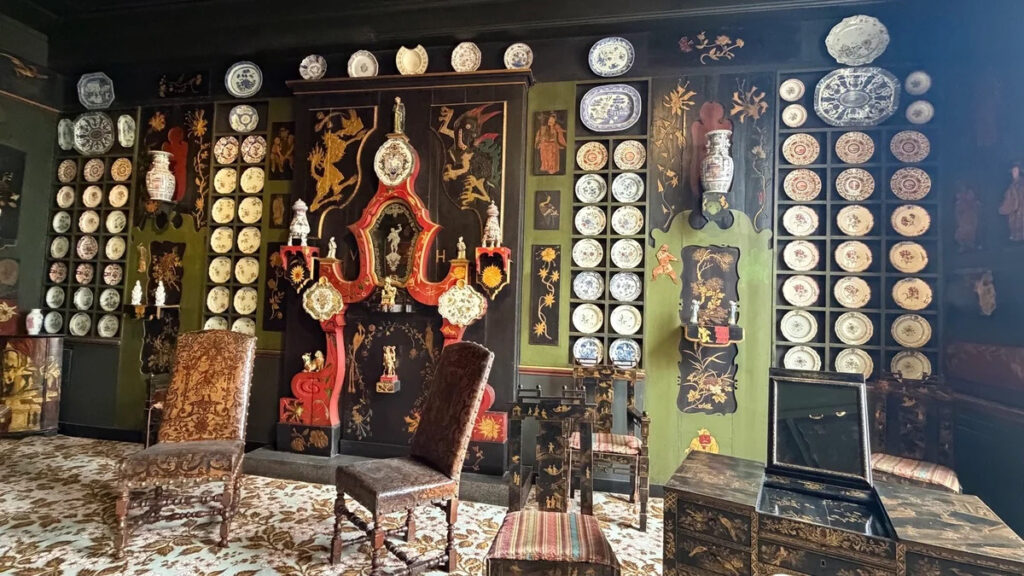
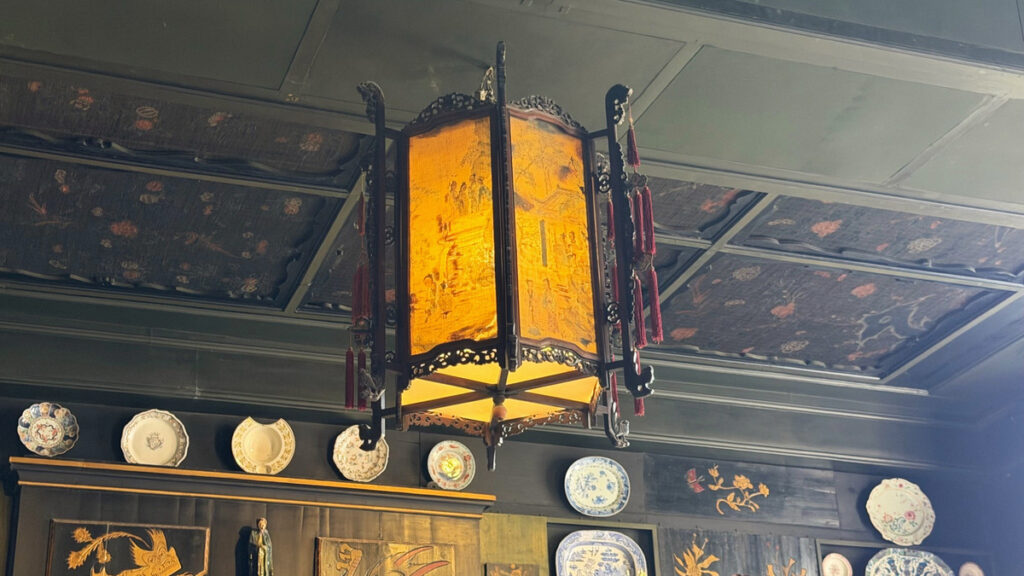
Entering the Chinese room, we arrive in the Guernsey years without leaving this Paris apartment. The glowing lantern has a dark wooden frame and red tassels. Figures and buildings are depicted on its panels; blue-and-white plates line the shelves, while flowers and imaginary creatures cover the woodwork. Working with craftsmen, Hugo had created these decorations for the house of Juliette Drouet, his longtime companion, in Guernsey. They were later brought to Paris and reassembled for the museum. A room from the years away has found a place in the home from before exile.
In the dining room, the pleasure of making continues. Hugo bought old furniture and handed it to carpenters to dismantle and reshape: a door becomes a table, a chest is turned into a bench or a sideboard. Alongside the writer, I imagine a man deciding on the shape of a furniture leg or the placement of a piece of wood. In exile, he was fashioning a home down to its smallest details, a place for everyday life when returning was still a long way off.
Juliette, too, writes within this shared life. Her letters to Hugo, from 1833 to 1883, span half a century. In them, she writes about herself, those around her and the events of her time. According to Florence Naugrette’s research, her memories of convent life helped shape part of Les Misérables. Beside the decorations made for Juliette’s house, her contribution to the making of a novel also comes to mind.
Later, while writing this piece, I place the photograph of the Chinese room beside the letter Hugo wrote to Captain Butler on 25 November 1861. Butler asks for his opinion on the French and British expedition to China. Hugo’s answer tells of two bandits: one plundered, the other set fire. He names them, too: France and England. He is writing about the looting and destruction of the Summer Palace in Beijing. He hopes that France will one day return the plundered possessions to China, and writes: “What time creates belongs to humankind.”
In the photograph, China has passed through the filter of nineteenth-century European taste and imagination; in the letter, Hugo stands against his own country’s actions. Earlier, in War on the Demolishers, he had written that the use of a building belongs to its owner, but its beauty belongs to everyone: “to you, to me, to all of us”. That “all of us” reaches beyond the room. It makes space for me, too, as a Persian speaker; for someone who can form a relationship with a work from another language, love it, criticise it and help preserve its meaning.
As the visit continues, the route through the apartment takes us to the years after his return: the study, then finally the bedroom. This last room is a reconstruction of the bedroom in another house, on Avenue d’Eylau, where Hugo died on 22 May 1885. The bed is the same, but the address has changed. Within a single apartment, we have travelled from his youth to the end of his life, although that life did not actually unfold within these few rooms. Objects have been brought from different homes so that we can follow a life scattered across them.
This gathering of objects was also the work of friendship. In 1836, at eighteen, Paul Meurice first crossed the threshold of Hugo’s home. Decades later, by donating his collection and working with the writer’s family, he helped establish the museum, which opened on 30 June 1903. Things that were once gifts, keepsakes or everyday possessions in a friend’s life have made this belated encounter possible.
One floor below, the exhibition Hugo and Architecture: From Stone to Quill presents us with other dwellings. Here, buildings sometimes emerge from ink stains. A portico begins to resemble a troubled face; a tiny castle appears in the corner of a dark mass. For a work entitled Burg, Hugo joined three floorboards and worked on the bare wood. These can be the materials of creation: ink, a few pieces of wood, and attention to a shape not yet complete.
The word “Burg”, meaning a fortified castle, takes us to the German lands, to the castles along the Rhine that Hugo had seen on his travels and that later found their way from his memory into his drawings. The letters from his 1840 journey also became The Rhine. This attachment developed at a time when the river itself was at the centre of border disputes; Hugo, too, was not untouched by the national claims of his time. Yet the buildings across the border remained in his imagination and entered his work. Looking at these castles, I think of the things we take from another country and keep with us, things that carry our relationship with that country beyond our judgement of its governments and its political disputes. The castles of the Rhine now stand before me in the home of a French writer: part of a world passed from one person to another through travel and writing.
In Souvenir, Paris is gathered onto paper: the Arc de Triomphe, the Vendôme Column, Montmartre, the towers of Notre-Dame and the Panthéon. The drawing dates from around 1864, from the years of exile. The Paris I can walk through today is here an image of a city from which the writer was separated. I think of the distance between a city and what remains of it in the mind. When we are far away, a small building, a window or a street corner can occupy a place in memory far greater than its actual size.
On the wall, Charles Hugo describes his father’s way of working: without a preliminary sketch, he would begin with a small detail, the gable of a house, for instance, and the city would gradually emerge from the whiteness of the paper. The description is familiar to anyone who writes. Sometimes we do not yet know where we are going; there are only details we do not want to lose. A sentence, an object.
Among the explanations of techniques and the dates of drawings, a child’s voice has also survived. Georges, Hugo’s three-year-old grandson, said after visiting Vianden Castle in Luxembourg: “Grandpa, I saw a beautiful broken house.” It is the summer of 1871. Hugo draws the castle, and years later his grandson’s words reach us beside the work. I read the date and the names of the techniques, but what I take away from this label is the voice of a child who chose the word “beautiful” to describe a ruin.
I leave the museum and return to the Place des Vosges. The Paris outside is the same city where, in October 2026, protests over the cost of living and the state of education have taken to the streets. On the eve of the demonstrations of 24 October, the closure of several museums, including this house, had been announced for security reasons. The news of these closed doors stays with me as I reread Hugo’s speech on destitution. It is 9 July 1849, and the voices of protesting deputies are preserved in the text too: he says that destitution can be destroyed. Objections come from the right, and he insists on his verb: destroy.
For me, rereading this speech is part of returning to Hugo’s house: hearing the sentences together with the objections they provoked when they were spoken. What we now call values took shape amid doubt, argument and defeat. Perhaps a house like this can offer a refuge in which to revisit that inheritance, a pause after which we return with greater attention to what is happening outside.
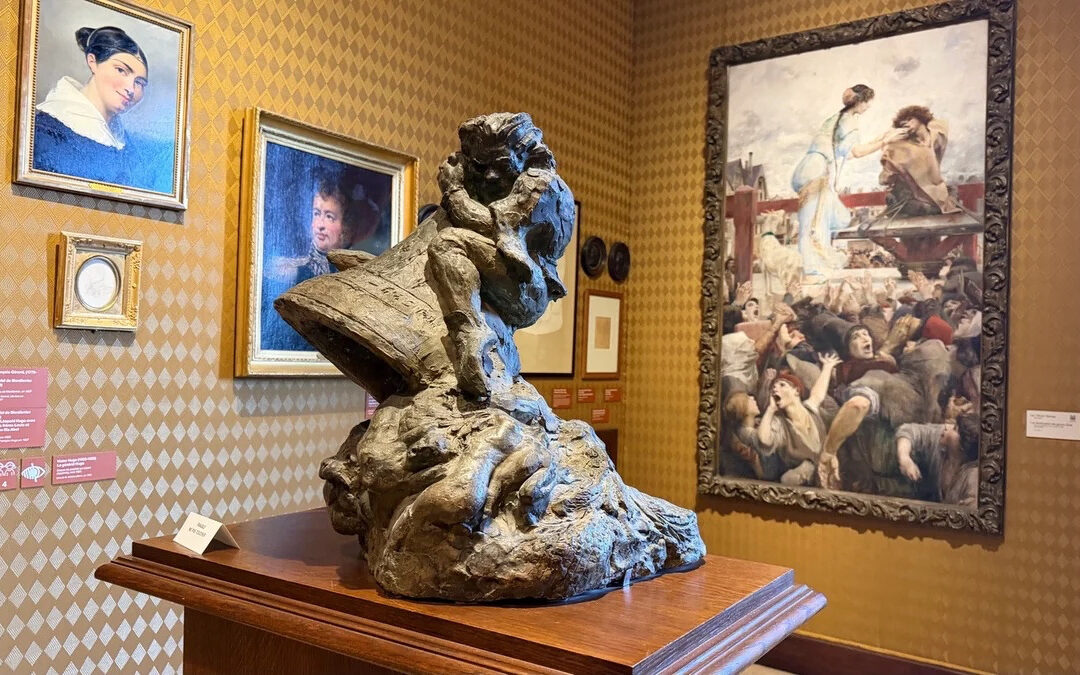
Among my photographs, I look again at Quasimodo: a grey, rough figure clinging to a bell. Through him and Esmeralda, Notre-Dame acquires a human face. I think of the scene in the novel where the crowd watches and mocks Quasimodo’s suffering, and Esmeralda gives the thirsty man water. A tear runs down Quasimodo’s face. Hugo has brought the reader so close to him that it is no longer easy to remain among the spectators.
The Hunchback of Notre-Dame has been translated into Persian. Without ever having seen this square or this house, we can reach that scene and reflect on where we stand in the face of another person’s suffering. For me, it is through such readings that Hugo becomes part of humanity’s shared heritage, in the lives of readers he never met, many of whose languages he did not know. Translators, too, make this encounter possible. I have left Hugo’s house, but to return, I can open a book in my mother tongue.