Skip to content

Human rights news

Two women killed in Kermanshah: when violence is hidden behind “family disputes”

By Negar Dadashloo

Two women have been killed, another has been injured, and the family’s 18-year-old son has been identified as the suspected gunman. Yet one of the first expressions used to explain what happened was the familiar phrase “family dispute”. It seems to offer an explanation, but sometimes it obscures the violence more than it clarifies the facts.

On the evening of Sunday, 4 October 2026, corresponding to 12 Mehr 1405 in the Iranian calendar, Fatemeh Lotfi, 46, and her daughter Zahra Shahbazi, 26, were shot dead in a house in the Pardis neighbourhood of Kermanshah. Another daughter was injured. Published reports identify the family’s 18-year-old son as the main suspect and say he fled the scene after the shooting. In its report of 5 October, the Hana Human Rights Organization stated that no official, verifiable information about his arrest had been published by that time.

One report described “escalating family disputes” as the background to the shooting. Another referred to a disagreement over an inheritance as a possible line of inquiry, while stressing that the police and judicial authorities had not announced a confirmed motive at the time of publication.

The information provided by these reports is therefore limited: two women have been killed, another has been injured, and a member of their family is suspected of carrying out the violence. The reports do not establish what happened before the shooting, whether there had been previous threats or violence, or what role a possible inheritance dispute may have played. These questions should be answered through an independent investigation and judicial proceedings, not through speculation about the victims’ private lives.

Even with this limited information, however, a broader question can be asked: when a killing takes place within a family, why does news coverage so often reach for “family dispute” before naming the violence?

A “dispute” describes a relationship, not a killing

A dispute may arise between two or more people over money, inheritance, personal relationships or life decisions. Those involved may argue, stop speaking to one another or go to court to resolve their disagreement. But shooting family members is not the natural continuation of a dispute. The move from disagreement to violence is a choice and an act by the person who commits it.

That is why the phrase “family dispute” cannot, on its own, explain a killing. It describes the relationship between people while pushing the perpetrator of the violence to the margins. Saying that an incident happened “following a family dispute” may inadvertently suggest a confrontation between two equal sides, as though everyone involved had been in an equivalent position and violence had been the inevitable outcome of an escalating argument.

There is no such symmetry in this case: two women are dead, another is injured, and a person is suspected of carrying out the shooting. A dispute, if there was one, is only part of the context. The killing is a separate act, whose perpetrator, responsibility and circumstances must be established.

This distinction is more than a matter of words. Language determines what the audience sees at the centre of an event. “Family dispute” directs attention to the relationship between the victims and the suspect; “armed violence within the family” directs it to the act itself and responsibility for it.

The family: a private sphere or a public responsibility?

The family is often understood as a private sphere, a place where others should not interfere. That understanding can lead even signs of violence to be treated as “a matter for the family” until irreparable harm has been done.

Privacy in family life is essential to autonomy and personal freedom. But it cannot mean that violence is private too. Threats, coercion, control, physical assault and killing are matters of social responsibility, protection and justice, whether they happen in the street or behind closed doors.

The United Nations definition of violence against women, cited by the World Health Organization, is not limited to physical harm. It also includes sexual and psychological harm, threats, coercion and arbitrary deprivation of liberty. In intimate relationships, violence may also take the form of physical aggression, psychological abuse, sexual coercion or controlling behaviour.

This does not mean that all these forms of violence were present in the Kermanshah case: the published information does not support that conclusion. The definition matters for a different reason. If protection systems intervene only when someone is killed or seriously injured, much of the opportunity for prevention has already been lost. Lethal violence may appear sudden, but prevention must begin long before the final shot.

Women killed within families are not isolated exceptions

Every case has its own circumstances, and global statistics cannot explain the motive for a particular killing. International data nevertheless show that women being killed by those closest to them is neither a marginal nor a rare phenomenon.

According to the joint estimate by the United Nations Office on Drugs and Crime and UN Women, nearly 50,000 women and girls worldwide were killed by an intimate partner or a family member in 2024. This represented around 60 per cent of the 83,000 women and girls intentionally killed that year. On average, 137 women and girls lost their lives each day at the hands of a partner or a family member.

These are global estimates and should not be applied directly to Iran or to the Kermanshah case. They do, however, reveal a reality: contrary to a common assumption, home is not necessarily the safest place for many women.

Understanding the scale of the problem in Iran requires regular publication of data that can be scrutinised. How many women are killed each year? What is the perpetrator’s relationship to the victim? In how many cases had threats been reported or previous violence recorded? Which institution had the victim approached before the killing, and what response had she received? How many cases lead to a conviction and the enforcement of a sentence?

Without such information, each killing is presented as an isolated event: a tragic news story that draws attention for a few days and is then forgotten. What remains hidden is a pattern that can only become visible through recording, comparing and following up on cases.

Prevention cannot be left to the victim

Many reports on violence end by advising women to seek help or leave an unsafe environment if they feel at risk. That advice may sound reasonable, but it leaves a fundamental question unanswered: if a woman asks for help, what practical support is available to her?

Leaving an abusive situation is not always a simple decision or something that can be done immediately. Financial dependence, concerns about children, family pressure, fear of escalating violence, the lack of a safe place to go and distrust of the authorities’ response can all make leaving difficult. Responsibility for prevention cannot fall solely on the person who is herself at risk.

The United Nations Essential Services Package for Women and Girls Subject to Violence stresses coordination between health services, social services, the police and the justice system. Risk assessment, safety planning, confidentiality and access to specialist support should be connected parts of a single system, rather than scattered services that someone facing violence must find on her own.

Asking for help matters only if an institution responds. Reporting a threat can save a life only if that threat is taken seriously. And advising someone to leave home is responsible only when there is access to a safe place, financial support, legal advice and effective protection.

The media’s responsibility begins with the first word

The media are not responsible for deciding who is guilty or establishing a motive before an investigation is complete. They must distinguish between confirmed facts, claims made by sources and possibilities still under investigation. But professional caution does not mean retreating into phrases that obscure the violence.

A “family dispute” may be part of a case’s background, but it cannot replace an accurate account of what happened. In Kermanshah, two women were shot dead and another was injured. That reality must come before any explanation involving inheritance, arguments or the victims’ private relationships.

Even the choice between “killings of women” and “femicide” requires care. We can say that two women were killed within their family. But determining whether these killings meet the precise definition of femicide requires more information about the motive, any history of violence and the power relations within this family. Feminist analysis gains credibility when it does not substitute assumptions for investigation.

The victims’ names must not disappear behind the label given to the incident. Fatemeh Lotfi and Zahra Shahbazi are not merely two figures in the statistics of violence. They were two people whose lives were ended by gunfire. Respecting them means neither inventing stories about their private lives nor minimising their deaths with a vague phrase. It also means continuing to ask about responsibility and prevention after the initial news coverage has faded.

“Family dispute” must not be the final explanation for a killing. If it refers to a real part of the context, it is only the beginning of the questions: how did a disagreement become lethal violence? Were there warning signs beforehand? What opportunities for intervention existed, and who should be held accountable?

Preventing such killings cannot be reduced to telling women to take better care of themselves. Safety requires a system that listens to threats, takes danger seriously, provides accessible support and does not allow responsibility for violence to disappear behind vague language.

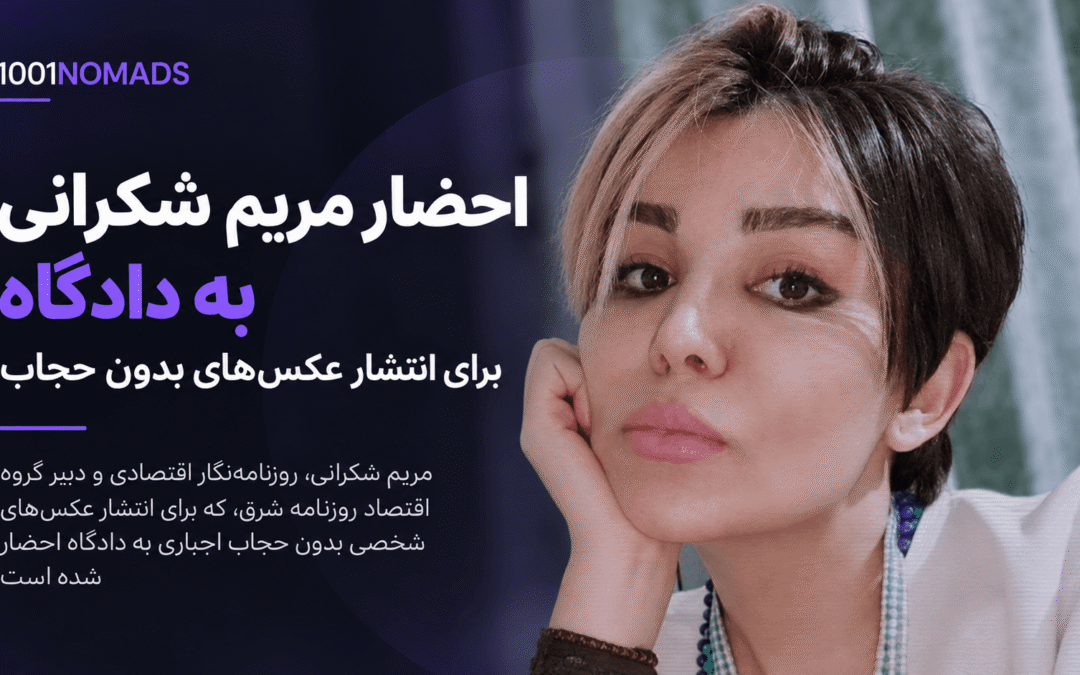
Maryam Shokrani summoned to court over photos she posted without a hijab

Maryam Shokrani⁠, business editor of the daily newspaper Shargh, says she must appear before Criminal Court Two at the Judiciary Complex for Government Employees in Tehran on October 19, 2026, for publishing personal photos of herself without the mandatory hijab. The new case reaches beyond her professional writing to how she presents herself in public as a woman and a journalist.

This time, Maryam Shokrani has been called to court over personal photographs. Her economic reporting and her writing about the death of Armita Geravand are separate matters. According to the summons she made public, the October 19 hearing concerns images she posted of herself on social media without the mandatory hijab.

On September 5, she wrote on her personal account on X⁠ that she had been accused of posting personal photos without a hijab on social media and that she had to appear before Criminal Court Two at the Judiciary Complex for Government Employees in Tehran on October 19, 2026. She added, “I don’t know why journalists’ cases are sent to the court for government employees!”

At the time of publication, the full indictment, the legal provision cited, the branch assigned to hear the case and the penalty prosecutors might seek had not been made public. A summons does not establish guilt. What is clear at this stage is the reason Shokrani herself gave for being called to court: the publication of personal photos without a hijab on social media.

Even before the legal details are known, the subject of the proceedings marks a shift. Judicial scrutiny has reached an image a journalist published of herself.

When the line between journalism and private life disappears

According to Shokrani, the proceedings concern her own photographs and what she is wearing in them. The distinction matters.

Maryam Shokrani has spent years writing about the economy, from inflation and markets to livelihoods and decisions whose effects extend beyond statistical tables into people’s everyday lives. She previously worked at the daily Shahrvand and now heads the business desk at Shargh. This case concerns her personal account, where the boundary between her professional work and her private life should be especially clear.

Since the “Woman, Life, Freedom” protests, posting pictures without the mandatory hijab has become part of everyday life for many Iranian women. Whether they see it as a political act or a form of protest is a question for the women themselves. A woman may post a photograph simply because she wants to show herself as she chooses.

When judicial authorities make that image the subject of a case, they bring a personal choice into the political sphere. Shokrani’s case raises questions about a woman’s ability to decide which images of herself to publish and what to wear in them. It also asks whether the rules governing women’s clothing in the street, at work and in public spaces should extend to a woman’s personal social media account.

From the Evin prosecutor’s office to the Armita Geravand case

Maryam Shokrani had previously been summoned by judicial and security authorities. On January 17, 2023, during the “Woman, Life, Freedom” protests, she was summoned to the third investigating branch of the Evin prosecutor’s office. She said she had been charged with “propaganda against the system” and was free on bail.

In autumn 2023, her writing about Armita Geravand led to another case. Geravand, a schoolgirl, fell into a coma after being injured on the Tehran metro and died several weeks later. The Iranian authorities denied that officers enforcing the hijab requirement had confronted her. Restrictions on journalists’ independent access to information and witnesses left significant questions about how she was injured.

In her public account of the case⁠, Shokrani said she initially faced two charges, “propaganda against the system” and “spreading false information.” According to her account, the first charge was dropped after she submitted documents showing that the material cited by the investigating magistrate had already appeared in Iranian media. The case continued on the charge of spreading false information.

The case moved between judicial authorities over questions of jurisdiction. Shokrani announced on her personal account that a court date had been set⁠. Branch 1058 of Tehran’s Criminal Court Two eventually sentenced her to a fine of six million tomans. She also wrote about the ruling on her account⁠.

In spring 2024, Branch 69 of the Tehran Province Court of Appeal overturned the lower court’s ruling and acquitted her. Her lawyer, Reza Shafakhah, said the case concerned Shokrani’s writing about Armita Geravand.

That history provides context for the new summons. The Geravand case concerned material Shokrani published as a journalist. According to her account, the new case concerns personal photographs.

Maryam Shokrani accused of “painting a bleak picture”

Less than a year after her acquittal, Maryam Shokrani was summoned again, this time by the Revolutionary Guards’ intelligence service in Tehran. On January 29, 2025, she appeared after receiving a phone call and was questioned for about two hours. According to accounts of the questioning, officers accused her of “painting a bleak picture” and threatened action against her without citing a specific example. It remains unclear whether the summons led to another court case.

“Painting a bleak picture” is a vague accusation with no clear legal boundaries. It can encompass reporting on poverty, economic crises, institutional failures and social problems, all of which make up a significant part of an economic journalist’s work.

Each summons had its own subject, date and issuing authority. This sequence alone does not establish a single case or a coordinated campaign against Shokrani. It shows how the pressure extended from her writing to the way she portrayed society and then to an image she published of herself.

When writing becomes riskier for journalists

In recent months, Maryam Shokrani has described what it is like to work as a journalist in Iran. In August 2026, the Committee to Protect Journalists contacted dozens of reporters in the country to document conditions for the press. Only five agreed to speak. Some were afraid to talk even anonymously, fearing repercussions for speaking to a foreign organization. Shokrani was one of the few who discussed her working conditions on the record.

She explained that during severe internet restrictions, a journalist might receive information by phone and have no way to check it against a photograph, video or document. Even after restrictions eased, internet connections remained slow, tools for getting around blocks were still necessary, video calls remained blocked and widespread online surveillance continued.

In Shokrani’s view, finding a source willing to talk was becoming harder by the day. She said professional journalism had been “pushed into the shadows” and that “writing has become much riskier.”

Shokrani’s main field is economic reporting. Her account shows how pressure on the press extends to work outside political coverage and reporting on protests. When a source feels unsafe even discussing unemployment, prices or market conditions, the line between an economic story and a matter for the security services has already blurred.

Reporters Without Borders ranked Iran 177th out of 180 countries in its 2026 World Press Freedom Index. The organization describes arbitrary arrests, harsh sentences, unfair trials, censorship and communications shutdowns as features of the country’s media environment.

That is the context in which Shokrani received her latest summons. The specific subject of this case is the personal photographs she published.

How enforcement of the mandatory hijab varies by setting

Shokrani was summoned at a time when Iran applies its mandatory hijab rules unevenly. In its World Report 2026, Human Rights Watch said the authorities continue to pursue women and girls who do not comply with the requirement. They impound vehicles, close businesses and use digital surveillance, including traffic cameras, to identify women. Implementation of the law commonly known as “Hijab and Chastity” has been suspended. The underlying hijab requirement remains in force.

At the same time, the authorities’ treatment of women without headscarves has varied according to the setting and the political role of their presence. At a government-organized rally marking the anniversary of the revolution in February 2026, state television, for the first time, interviewed and showed several women without headscarves who supported the government. In the official broadcast, their presence was presented as a sign of support and national solidarity. In other settings, the same women could face action over how they dressed.

In the months that followed, images of women without headscarves continued to appear at pro-government gatherings and in outlets close to the government. Meanwhile, women in independent settings continued to face summonses, and cafés, hotels and other businesses still faced closure over breaches of mandatory hijab rules.

The requirement remains in force, and its enforcement can be selective. State television can show a woman without a headscarf when her image serves the official narrative. A comparable photograph posted by a woman on her own account can become the subject of court proceedings.

Shokrani’s case arose in that context. The difference in treatment does not by itself establish the motive or the legal basis for the case. It does show how enforcement can vary with a woman’s public role, the setting in which she appears and the government’s political needs.

At the time of publication, the full case file, the prosecution’s arguments and the precise legal basis for the accusation had not been made public. Shokrani said she had been summoned to appear on October 19, 2026, before Criminal Court Two at the Judiciary Complex for Government Employees in Tehran for publishing personal photos without the mandatory hijab.

At the center of this case are the photographs the journalist published of herself


بیان قادری پس از احضار بازداشت شد؛ محل نگهداری او در ارومیه نامعلوم است

Bahar Ghadiri was detained after being summoned; the location of his detention in Urmia is unknown.

بیان قادری، زن کورد ۳۸ ساله اهل پسوه از توابع پیرانشهر، روز شنبه ۲۸ شهریور ۱۴۰۵ پس از مراجعه به دادگاه انقلاب این شهر بازداشت و به یک بازداشتگاه امنیتی در ارومیه منتقل شد. هنوز نام بازداشتگاه و اتهام مطرح‌شده علیه او مشخص نیست. بنا بر اطلاعات منتشرشده، بیان همراه پدر...

Maryam Shokrani summoned to court over photos she posted without a hijab

Maryam Shokrani summoned to court over photos she posted without a hijab

Maryam Shokrani, business editor at the daily newspaper Shargh, said she had been summoned to appear before a Tehran criminal court on October 19, 2026, for posting personal photos of herself without the mandatory hijab. The case raises questions about how far authorities extend control over what women wear, including on their personal social media accounts.

فدراسیون بین‌المللی روزنامه‌نگاران خواستار لغو اتهامات علیه یلدا معیری شد

فدراسیون بین‌المللی روزنامه‌نگاران خواستار لغو اتهامات علیه یلدا معیری شد

فدراسیون بین‌المللی روزنامه‌نگاران، حکم غیابی ۱۵ سال حبس علیه یلدا معیری، عکاس خبری ایرانی، را محکوم کرده و از قوه قضاییه جمهوری اسلامی خواسته است همه اتهامات مطرح‌شده علیه او را لغو کند. بر اساس بررسی ۱۰۰۱Nomads، بیانیه رسمی فدراسیون بین‌المللی روزنامه‌نگاران روز ۱۲...

از دانشگاه تا تبعید؛ چهار مجازات برای تارا فرهنگیان، دانشجوی ۲۱ ساله

از دانشگاه تا تبعید؛ چهار مجازات برای تارا فرهنگیان، دانشجوی ۲۱ ساله

یک سال حبس، ۳۱ ضربه شلاق، ۱۲۰ میلیون تومان جریمه و دو سال دوری اجباری از خانه؛ دستگاه قضایی جمهوری اسلامی برای تارا فرهنگیان، دانشجوی جوان کُردی که در جریان اعتراضات دی‌ماه ۱۴۰۴ بازداشت شد، مجازات را هم‌زمان بر آزادی، بدن، زندگی اقتصادی و جغرافیای زندگی او تحمیل کرده...

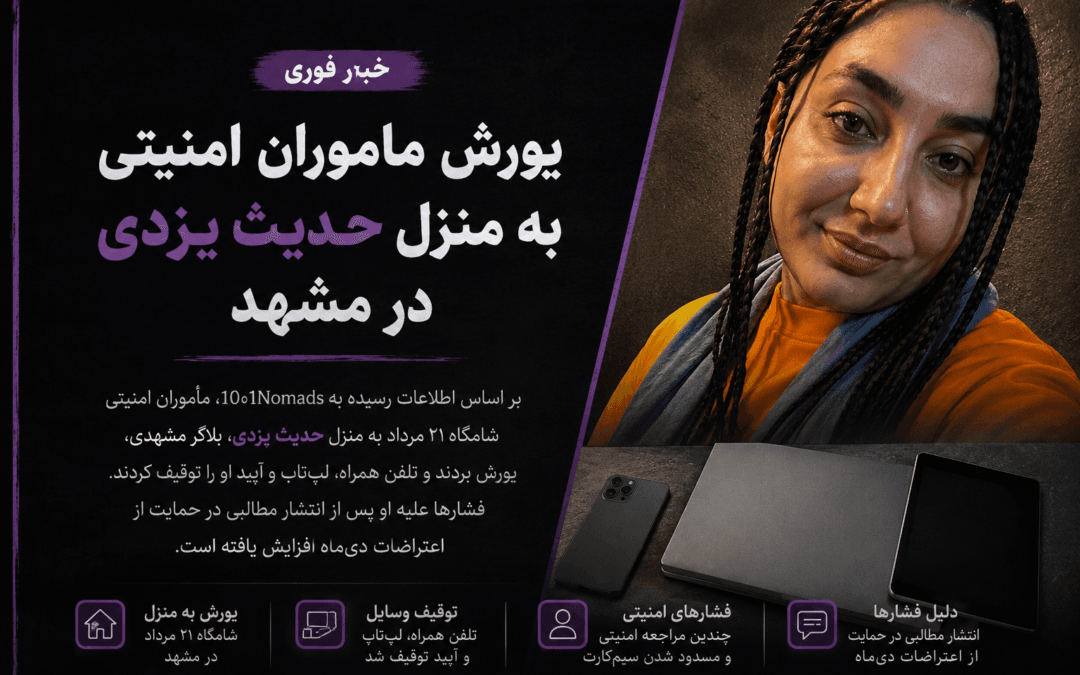
یورش مأموران امنیتی به خانه حدیث یزدی در مشهد؛ وسایل دیجیتال او توقیف شد

یورش مأموران امنیتی به خانه حدیث یزدی در مشهد؛ وسایل دیجیتال او توقیف شد

بر اساس اطلاعاتی که به 1001Nomads رسیده، مأموران امنیتی شامگاه چهارشنبه ۲۱ مرداد به منزل حدیث یزدی، بلاگر ساکن مشهد، یورش برده و تلفن همراه، لپ‌تاپ و آیپد او را با خود برده‌اند. یزدی در ماه‌های اخیر به‌دلیل انتشار مطالبی در حمایت از اعتراضات دی‌ماه تحت فشار نهادهای...

ویدا ربانی؛ زندان وقتی پشت درِ خانه ادامه پیدا می‌کند

Veda Rabani; Prison continues when the door of the house closes

ویدا ربانی این بار نه از پشت میله‌های اوین، بلکه از پشت درِ خانه‌ای می‌نویسد؛ دری که به روایت او، پلیس به همسرش کمک کرد تا به رویش بسته شود. ویدا یکی از امضاکنندگان بیانیه ۱۷ فعال سیاسی و مدنی⁠ علیه سرکوب و استبداد بود و هزینه امضایش را با بازداشت و خشونت پرداخت....

ساناز مهرابی کودکی ۱۵ ساله قربانی زن کشی در مرودشت

ساناز مهرابی کودکی ۱۵ ساله قربانی زن کشی در مرودشت

گزارش اختصاصی ۱۰۰۱ نومد قتل یک نوجوان ۱۵ ساله در مرودشت، بار دیگر پیوند میان زن‌کشی، کودک‌همسری، کنترل خانوادگی و خلأ حمایت قانونی از زنان و کودکان در ایران را آشکار کرده است. بر اساس اطلاعات رسیده به تحریریه، ساناز پس از مخالفت خانواده با ازدواج موردنظرش، با شلیک...

آزاده یعقوبی به سه سال و شش ماه حبس محکوم شد

آزاده یعقوبی به سه سال و شش ماه حبس محکوم شد

آزاده (معصومه) یعقوبی، از بازداشت‌شدگان اعتراضات سراسری دی‌ماه ۱۴۰۴ و زندانی محبوس در زندان وکیل‌آباد مشهد، از سوی دادگاه انقلاب مشهد به سه سال و شش ماه حبس تعزیری محکوم شد. بر اساس گزارش‌های منتشرشده از سوی منابع حقوق بشری، این حکم به اتهام «اجتماع و تبانی به قصد...

بازداشت دوباره مهشاد کشانی در اصفهان؛ تشکیل پرونده جدید و بی‌خبری از محل نگهداری

بازداشت دوباره مهشاد کشانی در اصفهان؛ تشکیل پرونده جدید و بی‌خبری از محل نگهداری

مهشاد کشانی، دانشجوی ۲۲ ساله، مدت کوتاهی پس از آزادی بار دیگر در اصفهان بازداشت شد. محل نگهداری او نامعلوم است و پرونده‌ای جدید علیه او تشکیل شده است. چهار مأمور لباس‌شخصی صبح ۱۲ مرداد ۱۴۰۵ مهشاد کشانی را در منزل خانوادگی‌اش در اصفهان بازداشت کردند. او با اتهام‌های جدید امنیتی مواجه شده و از محل نگهداری و وضعیتش اطلاعی در دست نیست.