By Sharareh Mehboudi
For Laurent, who took us to his village and so generously shared the beauty of his homeland with us.
Seven years had passed since I left Iran. I was living in Paris then and had come south for the holidays.
When I opened my eyes, there in the mountains around Saint-Guilhem-le-Désert was a landscape I knew: pale rock, trees scattered across the slopes, bushes growing out of cracks in the stone. I wanted us to stop. I had only just learnt the name of the village; the mountains were already familiar.
For a few moments, I could have been in southern Iran. I thought of the foothills of the Zagros and my father’s house. Even the distance between the trees was familiar, the way the green on a hillside still lets you see the shape of the land, the walls and hedges so close in colour to the earth and stone around them. When we set out that morning, I had no idea this village would bring me so close to home. I didn’t yet know the name of the stream. I had read nothing about the abbey. But to look at those slopes, I needed no translation.
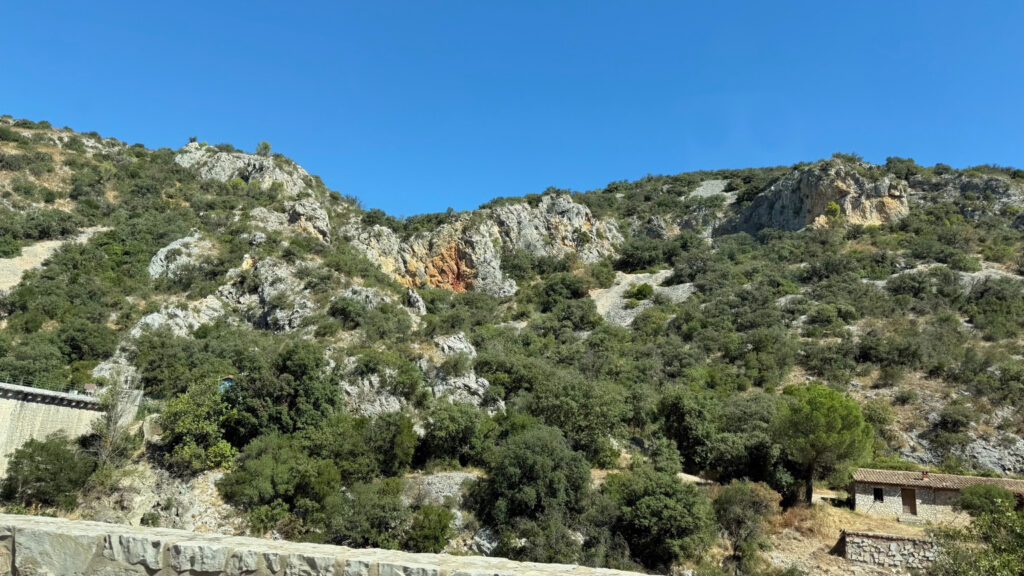
Saint-Guilhem-le-Désert lies in the Gellone Valley, in the Hérault département of Occitanie. The Verdus stream runs past its houses. Their walls are so nearly the colour of the mountain that, from a distance, the village looks like part of the slope. I wanted to know what kind of life the people of this valley had made with the stone, the soil and the trees that looked so familiar to me.
Our walk began just outside the village, at the Devil’s Bridge, where the River Hérault cuts through the rock. We had come to a place where people had stories to tell about the stones and the roads.
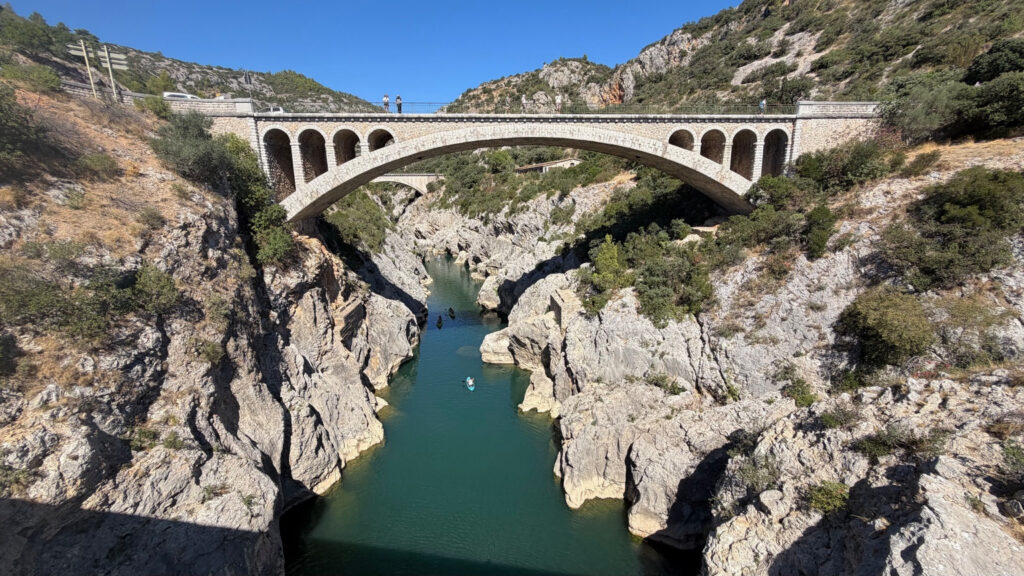
On a sign beside the path, someone had drawn a pilgrim, a shepherd and a potter side by side. We had come here for a walk. Once, this same road had taken one man on a pilgrimage, another to pasture with his flock, a third across the river with a load of earthenware jugs. The abbeys of Aniane and Gellone built the stone bridge together in the early eleventh century. The devil got to put his name to it.
In the local legend, the devil came every night to tear down whatever the builders had put up that day. At last Guilhem offered him a bargain: build a bridge that nothing could bring down, and in return he could have the soul of the first creature to cross it. When the bridge was ready, they sent a dog across. In one telling, they even tied a saucepan to its tail. Furious at being tricked, the devil tried to break the bridge. When he couldn’t, he threw himself into the river.
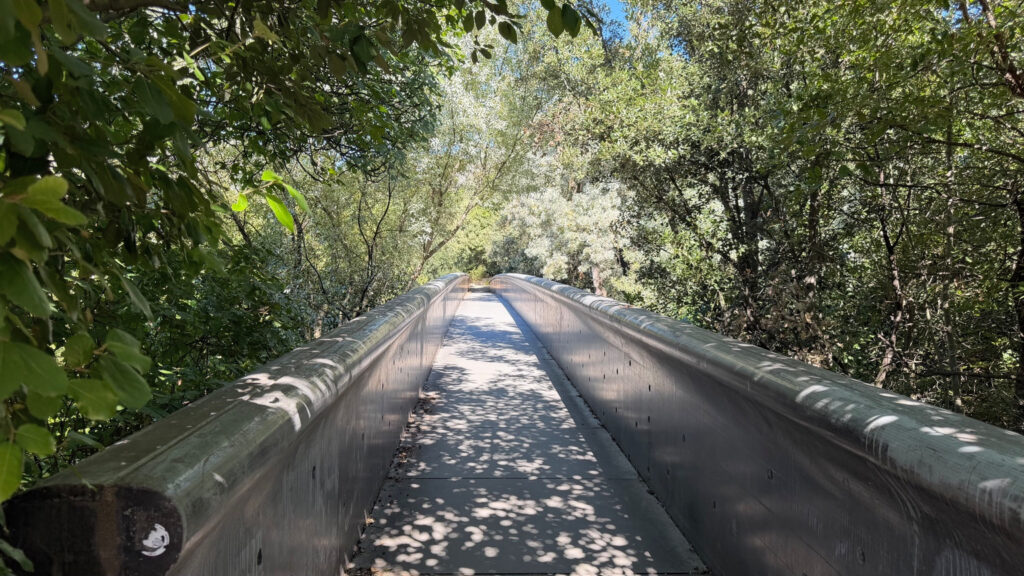
A little further on, the Footbridge of the Angels, designed by Rudy Ricciotti, spans a hollow in the ground. It is a slender structure of fibre-reinforced concrete, with no supporting pier in the middle. The sign explained that its dark grey was chosen to match the colour of a shadow, so the bridge would scarcely catch the eye. Below the dimensions and construction details came an invitation: stop halfway across and entrust a wish to the wind. It might reach an angel’s ear. The names of those two crossings stayed together in my mind. On one, you’d be wise to let someone else go first; on the other, you were given a reason to linger.
Another sign along the path described four small ponds created for wetland plants and animals. The frogs, dragonflies and water insects each had a name beside their picture. One creature clung to a twig; another walked across the water on long legs. Before we reached any of the famous monuments, someone had thought to draw our eyes down to the foot of a blade of grass.
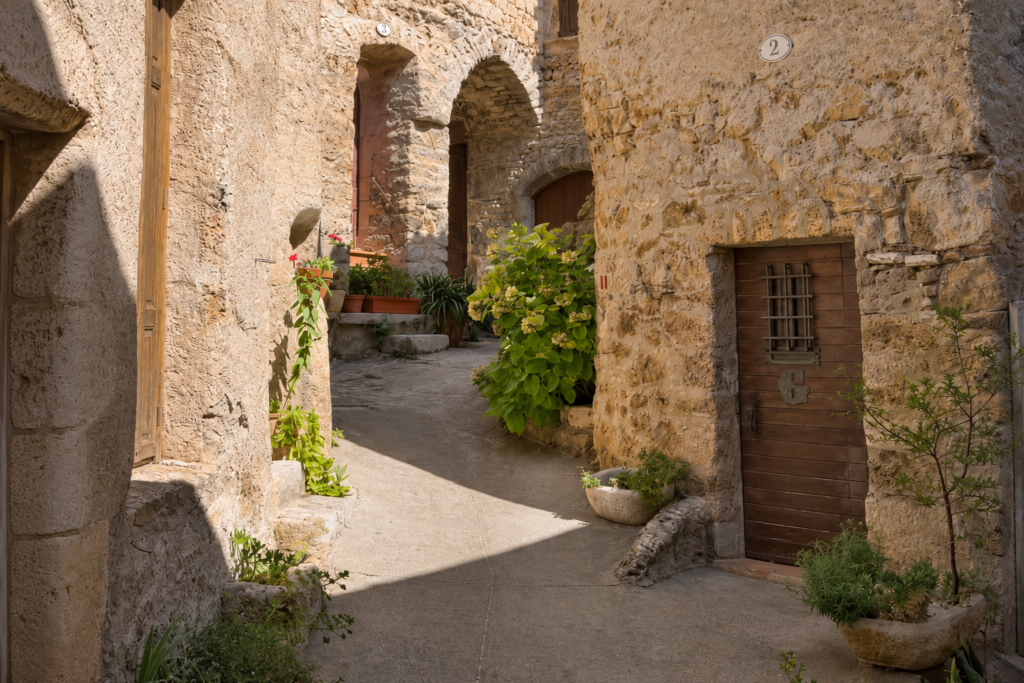
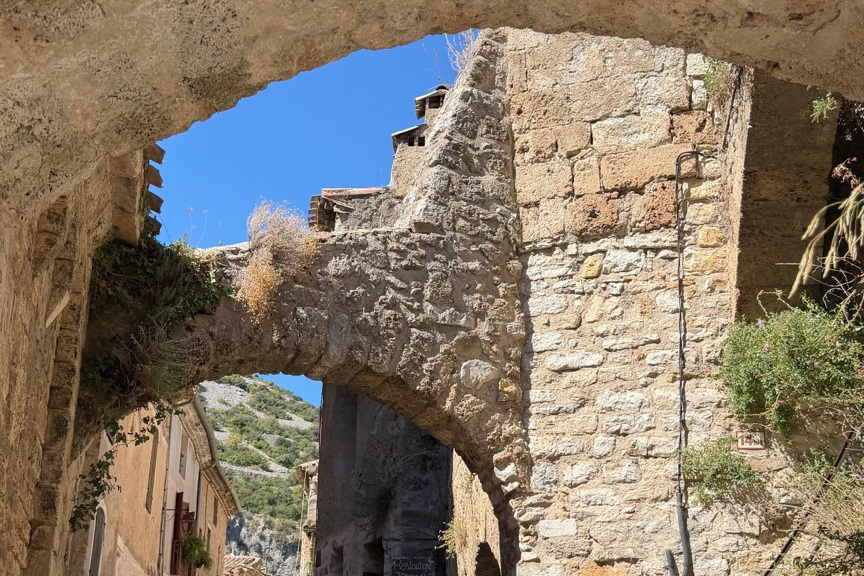
I was in the south of France, still looking at the landscape partly through my memories of Iran. At the end of one lane, the mountain was visible through two stone arches, one behind the other. A few steps in the shade and the sunlight was back on the stones. Ivy covered a wall; the shadow of a railing fell step by step down a flight of stairs. An iron lantern projected from a house front. Outside a shop stood a spinning wheel beside some orange flowers, with a red flag hanging overhead.
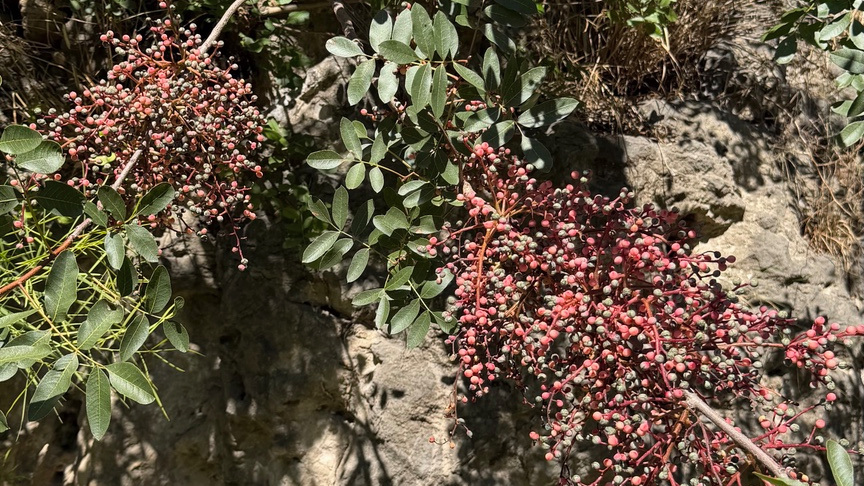
We climbed the steps to Laurent’s father’s house. Now we were right in the heart of the mountains. I looked up and murmured, “Wherever I am, the sky is mine.” When I turned my head, I saw the clusters of baneh: little green and pink fruits on red stems. I went over to the tree and tasted one. There it was, the taste of Iran in my mouth. Wild pistachios!
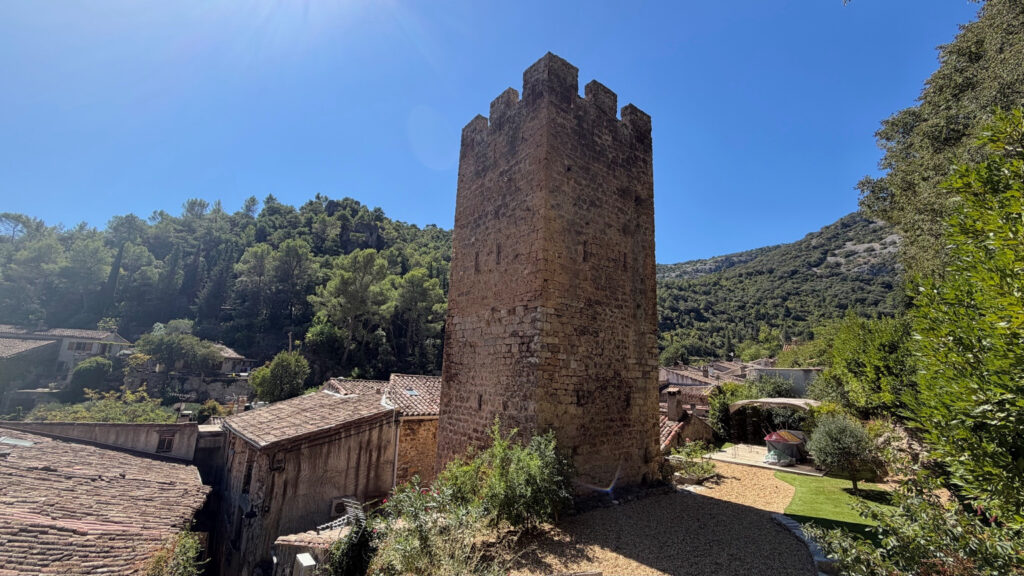
When I’m moved, it gets harder to find the words in French. That day was no exception. Still, I tried to explain to my companions what the fruit was. They didn’t know it, and I invited them to try one. I told them about baneh and kolkhang, about the Bakhtiari families who climb high into the Zagros to gather the fruit, then dry it and mix it with roasted wheat.
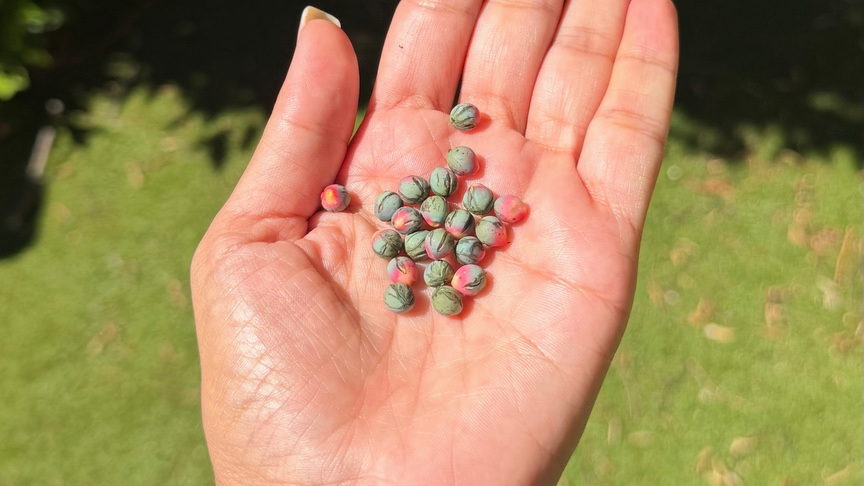
Until then, it had been my host teaching me the names of roads and buildings. But under that tree I felt at home, back in the foothills of the Zagros. I knew the plants there; I could have talked for hours about any one of them. For once, I could tell someone about Iran without reaching for a photograph or trying to describe a landscape far away. The fruit was right there in front of us.
I could happily have sat under that tree for hours, thinking of home. But it was time to go.
We left the house and found our way back into the lanes. In the narrowest ones, only a ribbon of sky showed overhead. A few steps led up to a door; a flowerpot stood on the threshold, and a plant trailed down from the top of a wall. The old part of the village still has its paired windows and arched doorways. From some doors hangs a cardabelle, a dried, prickly flower. People here say you can tell what the weather will do by the way it opens and closes.
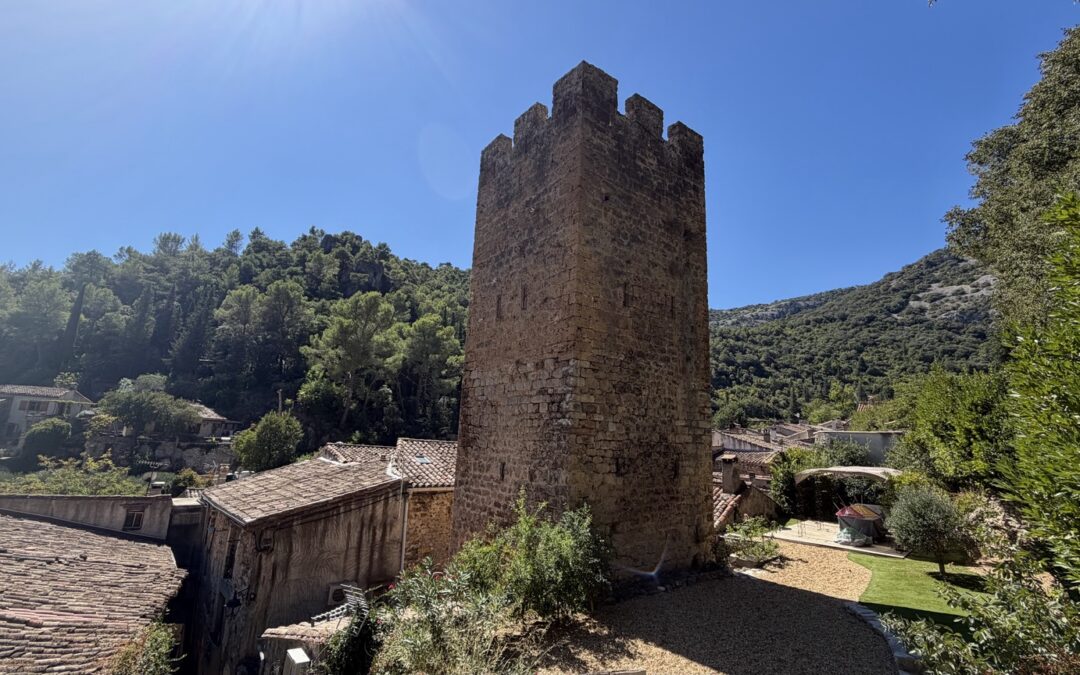
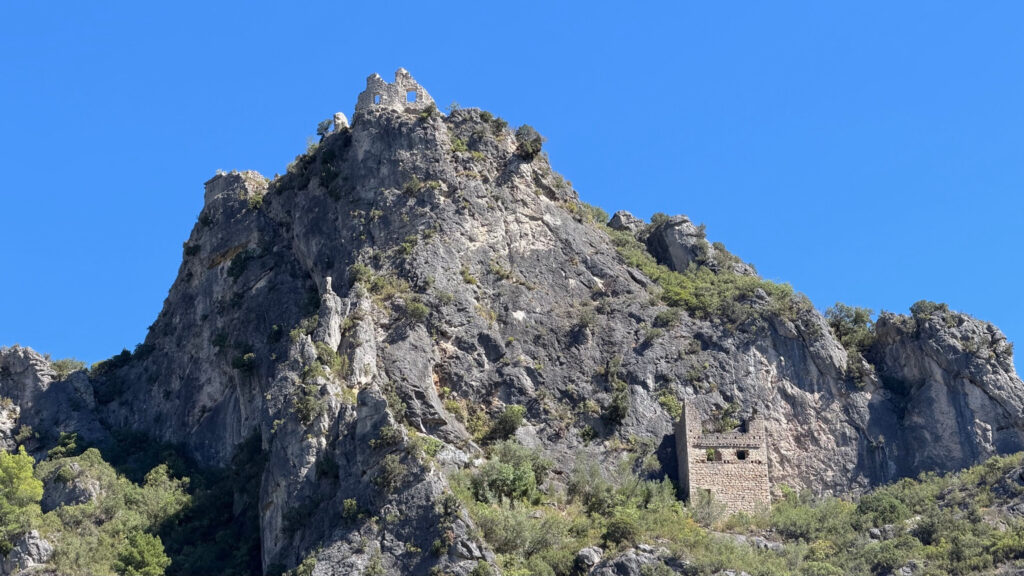
High on a rocky spur above the village, you can still make out the walls of the Giant’s Castle. What remains probably dates from the twelfth century. Legend has it that a giant lived there with a magpie. To get near him, Guilhem dressed as a serving woman and hid his sword. The magpie recognised him and called out a warning. Sure of his own strength, the giant opened the gate anyway. Their fight ended with the giant falling from the cliff. The magpie left the valley.
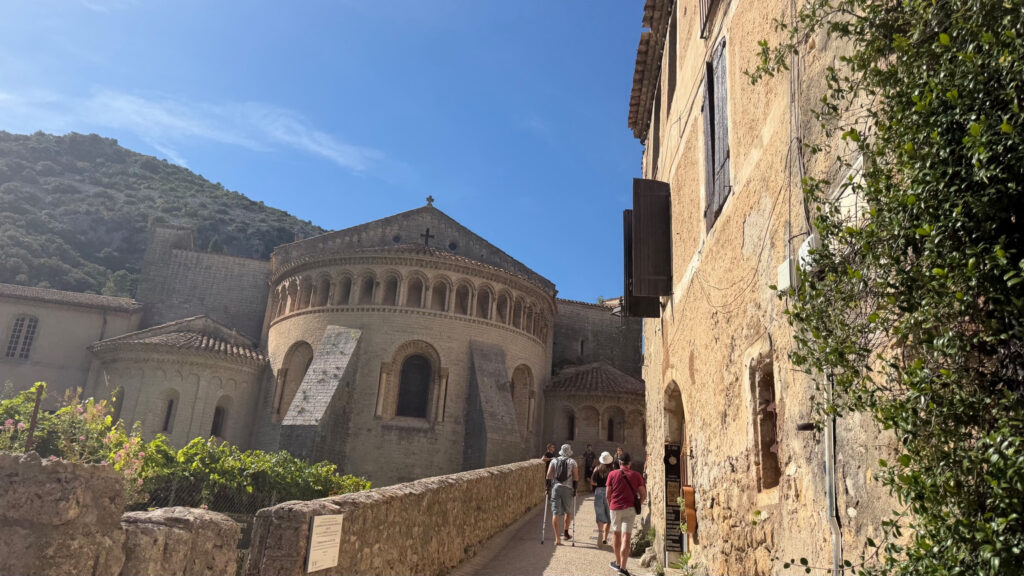
In 2022, work began to stabilise the ruins. Stonemasons lowered themselves on ropes to reach the walls. Knowing that changes how I see those ruins on the skyline. I can still picture the giant and his magpie, but now I can also see the masons hanging from their ropes, keeping the last walls standing.
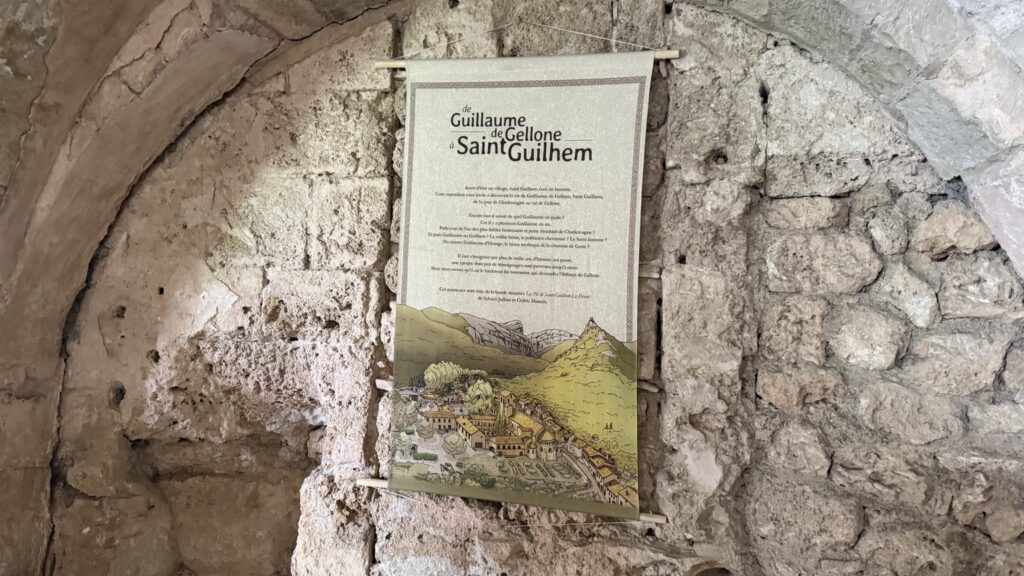
At the abbey, I read a line on an exhibition panel: “Before it was a village, Saint Guilhem was a man.”
Guilhem is the Occitan form of Guillaume, or William. He was a relative of Charlemagne and one of his military commanders. In 804 he founded the Abbey of Gellone. Two years later, influenced by his friend Benedict, founder of the Abbey of Aniane, he became a monk. The sign we had seen near the bridge told their story under the heading “Two Friends, Two Abbeys”. The “desert” in the village’s name refers to the solitude Guilhem sought in monastic life. He died here in 812.
The exhibition drawings showed him first at court and on the battlefield, then in a monk’s habit. We know the year he founded the abbey. What went through his mind between his last battle and his first day as a monk, we don’t know. In time, the poets of the medieval chansons de geste would make another man of him: Guillaume d’Orange, William of Orange.
Pilgrims came to Gellone to pray at Guilhem’s tomb and to venerate a splinter of wood held in Christian tradition to be a fragment of the True Cross. According to that tradition, Charlemagne had given it to Guilhem. The village became a stopping place on the way to Santiago de Compostela. In one of the lanes, the pilgrims’ scallop shell still hangs on the sign of a guesthouse. In 1998, the abbey and the Devil’s Bridge were inscribed on the UNESCO World Heritage List as part of the Routes of Santiago de Compostela in France.
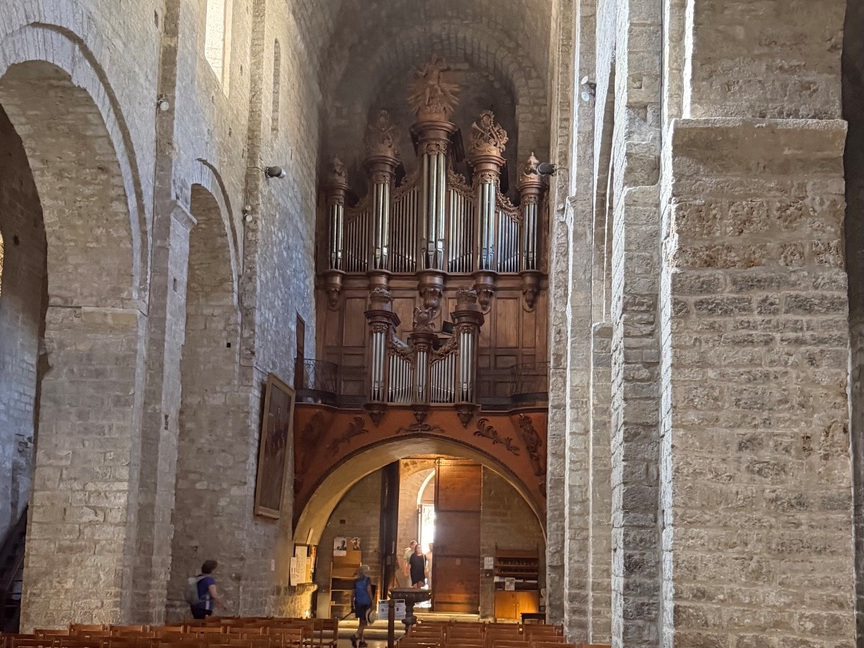
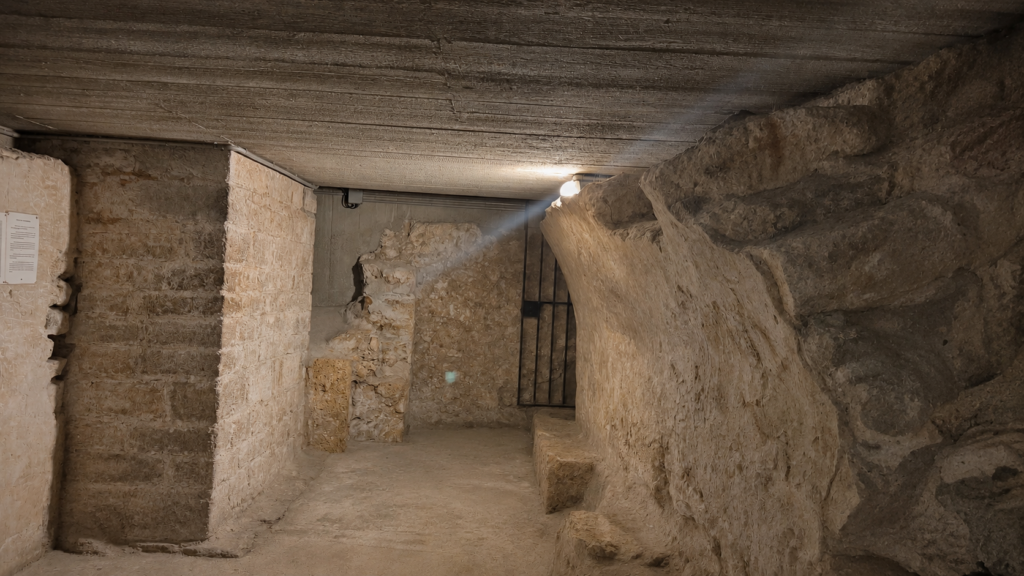
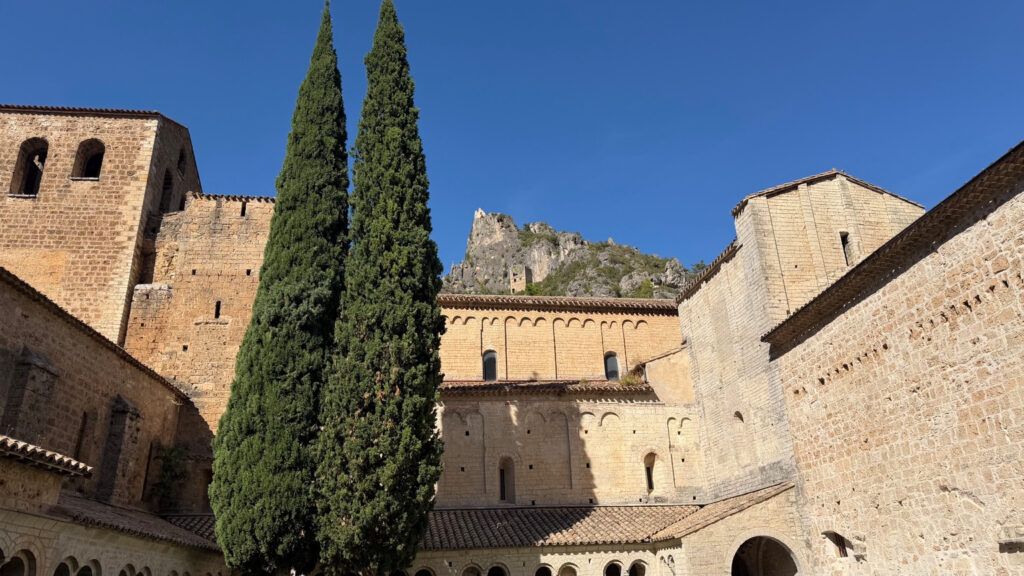
At the entrance to the church, one word stood out in large letters: “SILENCE”. Outside, shopfronts and windows had kept drawing my gaze from one side of the street to the other. Here my eye had time to follow a single line, up from the foot of a wall to the curve of the barrel vault over the nave. Candles burned in a corner. The main part of the Romanesque church dates from the eleventh century. Beneath it lies the crypt of an earlier church, forgotten for centuries.
Excavations in 1962 and 1963 brought it to light again. A reconstruction drawing showed two small vaulted aisles, stairways at the sides and a passage running across them. Pilgrims had once walked through here to venerate the relics. The crypt was later filled in, its vaults destroyed. Standing in front of that drawing, I could trace a pilgrim’s footsteps along a path that no longer existed in quite that form.
The altar known as Saint Guilhem’s dispelled any notion I had of a past all in grey. Coloured glass had been set into white marble. One panel shows Christ enthroned, the other the Crucifixion. Stems and leaves curl around both scenes. The altar is thought to date from the twelfth century. Beside the description of the carvings, a photograph showed what salts were doing to the marble. As humidity changes, the salts crystallise; pressure from the crystals makes the surface flake away. To save those faces and delicate leaves, conservators have to draw the salts out of stone that is already fragile.
The cloister, with its covered walks around the courtyard, has had troubles of its own. The abbey was damaged during the sixteenth-century Wars of Religion, and efforts were made to restore it in the following century. After the French Revolution, the abbey’s property was sold. Some stones went into other buildings; carvings found their way into private collections. In the nineteenth century, the village priest, Léon Vinas, gathered up scattered fragments. Some of the columns had much further to travel. In the early twentieth century, the American sculptor George Grey Barnard bought a number of them. To see them today, you have to go to The Met Cloisters in New York.
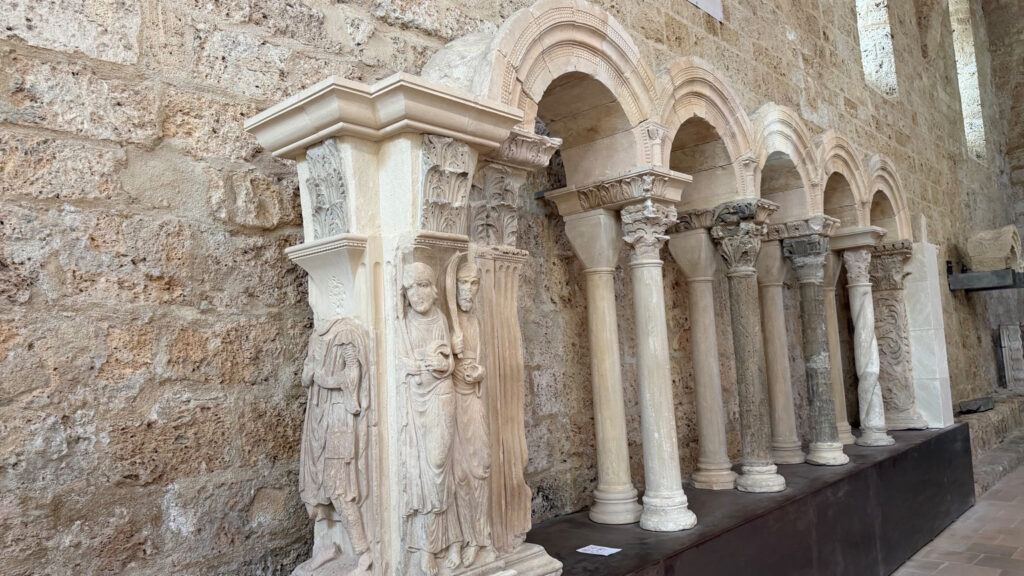
In the village itself, the abbey museum occupies the monks’ former refectory. By studying the fragments and using three-dimensional modelling, researchers were able to put five of the cloister’s arches back together. Those few arches took years of work. Someone had to turn each stone over, look at it from every side and work out which other stone it belonged beside. An exhibition called The Birds of Time asked a little of that patience of the visitor, too. On one carved pilaster, all I could see at first were leaves. I had to come closer and follow the line of a stem before I could make out a wing among the foliage, and then a beak.
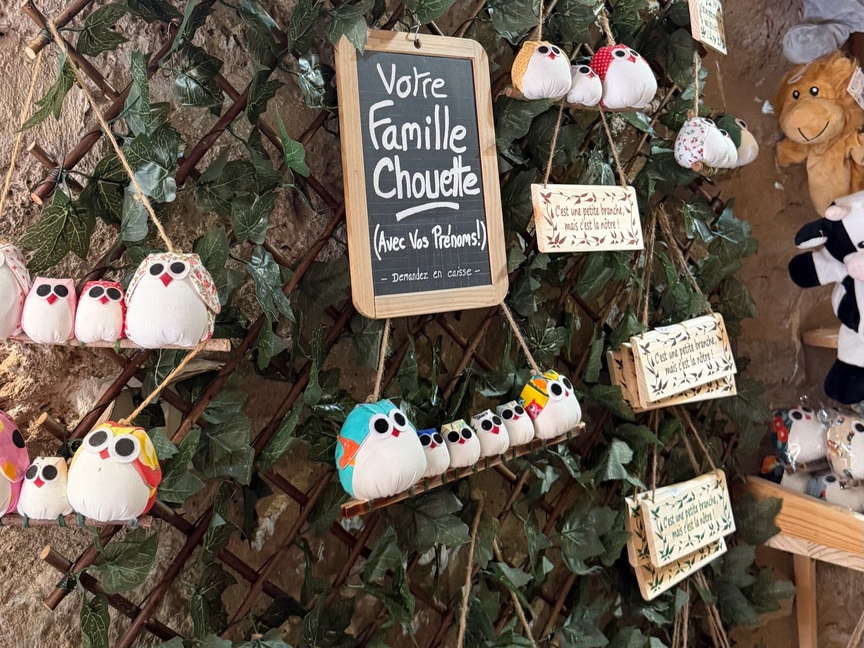
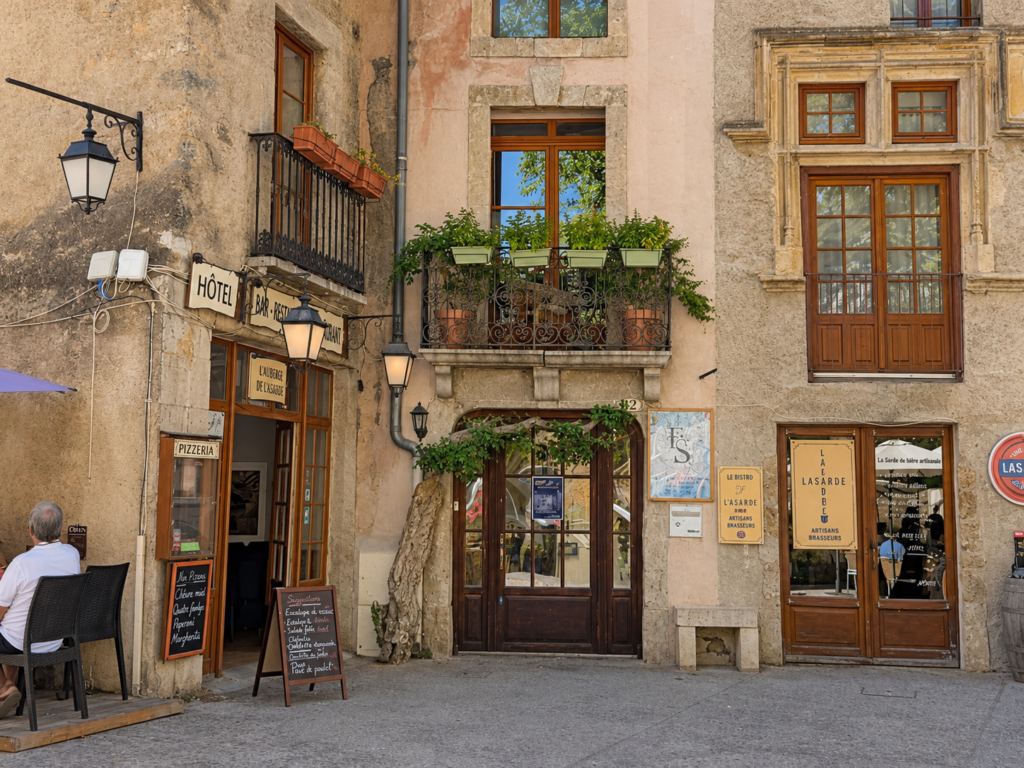
Outside the abbey there were birds, too, this time made of cloth. In one shop, little owls perched on branches in family groups. You could have your own family’s first names added. “Votre famille chouette”, the chalkboard offered. In French, chouette is an owl, but it’s also what you might say about something you think is lovely. A little further on stood Pinocchio in a red cap. Someone had turned an old metal container into a sign advertising soap made from goat’s and donkey’s milk. Among all those old stones, the people who lived here now had found room for their own tastes and jokes.
People have long made things by hand in this valley. In neighbouring Saint-Jean-de-Fos, potters have been making pots, jugs and materials for building houses since the Middle Ages. The potter I had seen drawn on the sign by the bridge belonged to that history. In the Place de la Liberté, a date of a rather different kind caught my eye. The village had kept a record of the exact day its “King Plane Tree” was planted: 20 January 1855. Among all the dates of battles, foundations and demolitions, someone had remembered the day they planted a tree.
We had lunch at Chez Barmy. Under coloured awnings, beside a stone wall and hand-lettered chalkboards, I opened the menu. One of the boards spoke of solidarity and support for the local economy. I read about the lamb from the Larzac and the cheeses of the region, then turned to a page that began, unexpectedly, with a question: “Barmy, who are you?”
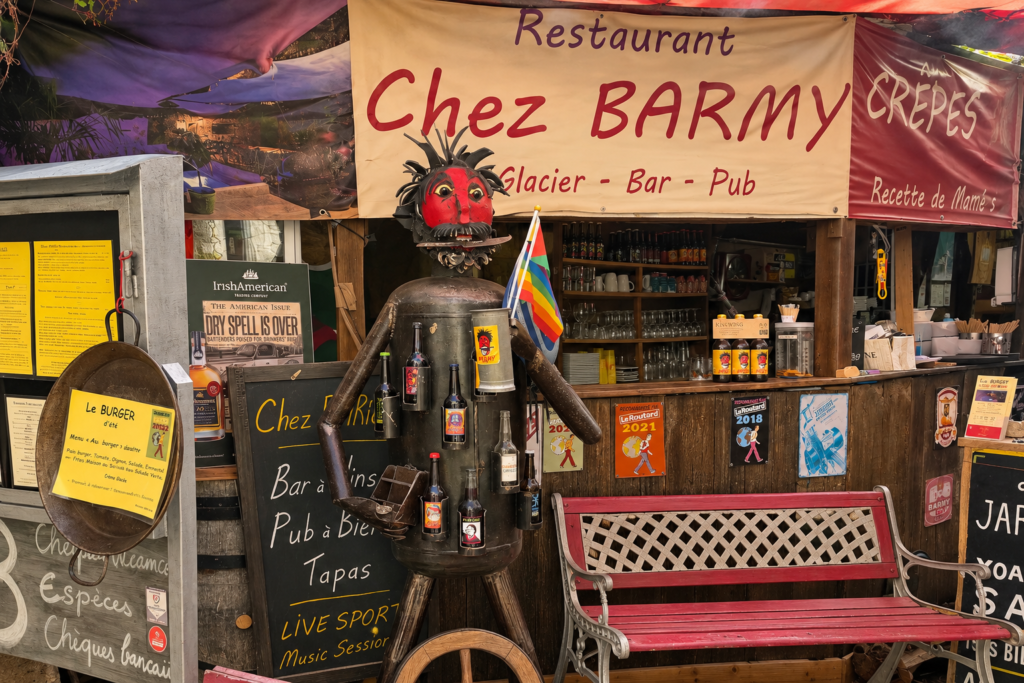
Our host, Gilles Nicaise, had come across the name Félix Barthélémy Bouque, known as Barmy, while researching local history in the Hérault archives. Barmy had been a priest before taking up medicine. During the cholera outbreak of 1854, he tended the sick of the village day and night. For a time, he was also its mayor. Local disputes took him to Aniane, where he became a doctor to the poor. In the winter of 1889, smallpox broke out among the men working on the dam and irrigation canal. Barmy returned to the village and, according to Nicaise’s account, vaccinated more than six hundred people.
Barmy also held literary gatherings at home to keep the Occitan language and its culture alive. Long after his death, his grave lay neglected. Nicaise helped get it restored and put the doctor’s name above the door of his restaurant. A few lanes away stood an abbey whose founder had been celebrated in epic verse. Here, over lunch, I had met a man whose name might never have made it out of the archives.
I later read that for the Feast of the Cross in early May, people bake small, cross-shaped loaves and have them blessed, in memory of the bread the monks once gave to pilgrims. Some families keep the loaves in the belief that they protect everyone under their roof. We weren’t there for the feast. What we brought home from the valley, on our guide’s advice, were olives and olive oil, among the best I’ve ever tasted.
It was the olive oil that later led me to a piece by the Occitan writer Max Rouquette. He remembers Maundy Thursday, when the villagers laid empty snail shells on a thin bed of sand around the doors and windows along the route of the procession. Into each shell they poured a little of the dark oil from the final pressing, unfit to eat, which they called “hell’s oil”. At nightfall they lit these tiny lamps, and the outlines of doors and windows emerged from the dark.
I never saw that night. What I have from our day walking the length and breadth of the village is a photograph of the lane with the two arches, one behind the other. Thanks to Rouquette’s memory, I can now imagine the light of a single snail shell on one of those thresholds. At the far end of the photograph, you can see the mountain. It still reminds me of the Zagros and my father’s house. But now the lane itself is part of my memory, too. One day I’d like to walk beneath those two arches with a friend from Iran and show them this corner of France the way it was shown to me.