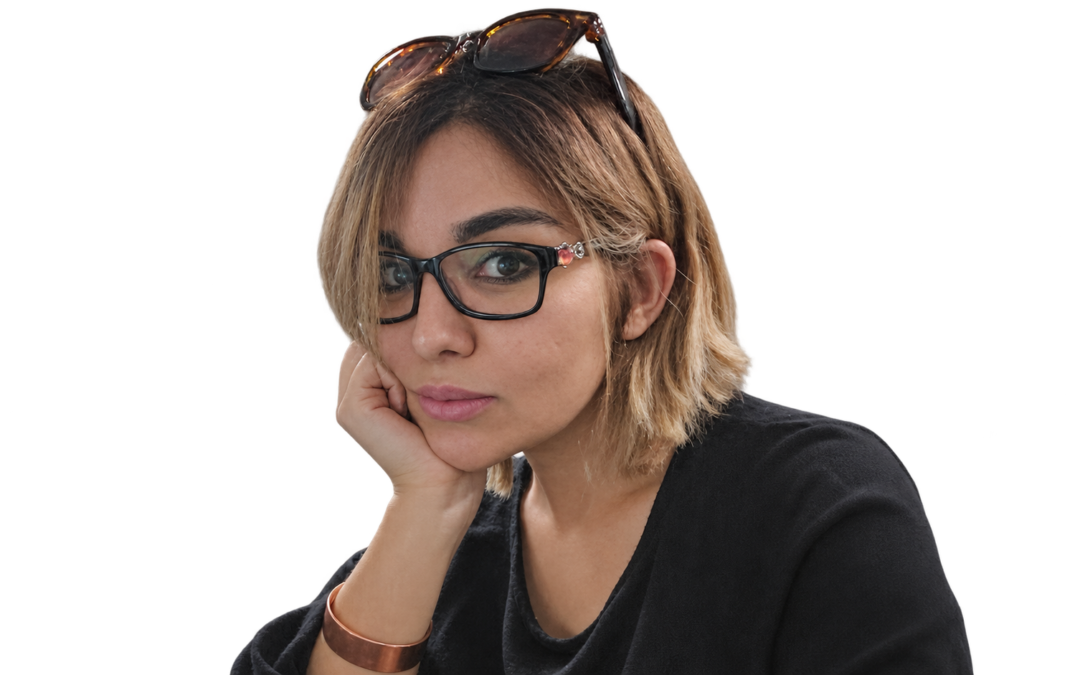
Maryam Shokrani’s mother cut letters out of cardboard and put them together to teach her daughter to read. By the age of five, Maryam was already reading with ease. A few years later, when her first satirical pieces appeared in a magazine, her family bought and kept the issues and showed friends her name in print.
Kioumars Saberi Foumani, known as Gol Agha, gave her her first chance to write. From him she learned that satire could be a form of criticism. Years later, when she took charge of a business desk, another piece of advice from her editor-in-chief stuck with her: check the information yourself, even when it comes from the most reputable sources. She now trains young journalists, most of them women, free of charge.
In this interview, 1001 Nomads asked Maryam Shokrani how she went from writing satire for children to covering the economy, what changed in her work when she became an editor, and why she still wants to go from street to street and alley to alley, looking for stories to write.
1. Could you give us the spelling of your name in Persian and Latin script, your date and place of birth, and the details of your education, including where, what and when you studied? What kind of environment did you grow up in?
My name is مریم شکرانی, or Maryam Shokrani in Latin script. I was born on 22 Dey 1367 in the Iranian calendar, in Shiraz, Iran. I have a master’s degree in journalism from Soureh University.
I was the eldest child in my family. In a patriarchal society, my family strongly supported women’s right to study, work and be independent. They weren’t particularly religious, and that gave me more freedom than the girls around me had. I could be ambitious and challenge some taboos.
I was a top student at school. I belonged to groups for high-achieving students and was shortlisted in the physics and mechanics category of the Khwarizmi Festival. I took the mathematics track in high school and loved both math and physics. But I thought there was little room for me to advance in those fields in Iran and that I would probably end up teaching one of them. That was a long way from my dream of doing research and working in major laboratories. So I decided to become a journalist.
2. What is your earliest memory of wanting to read, write or ask questions? Was there a person, book, newspaper or event that played a particular role?
My mother introduced me to books and magazines. Before I started primary school, she cut letters out of cardboard and taught me to read by putting them together. I was reading easily at five. Whenever she came home from being out, she brought me books and magazines. I had more of them than I had toys.
Books made me ask questions. Reading Isaac Asimov excited me and fired my imagination. I was always curious about how other people thought about things. I would go over their arguments in my head and see which ones struck me as the most reasonable and logical. I loved that mental game.
3. In your family and the community where you grew up, what kind of future did people want for a girl? What did you want for yourself, and how did people react when you chose journalism?
My family admired independent women. They were proud of how well I did at school and tried to help me develop with the limited resources they had.
When I chose journalism, they supported me. I remember how eagerly they bought and kept the issues that carried my first published pieces. They proudly showed my name in the magazines to family friends.
4. Tell us about your first days in a newsroom and your first published piece. Who gave you a chance, and what have you carried from that experience into your work?
As a child, I competed in science competitions up to the national level. I also placed in competitions for track and field, literature, fiction writing, satire and cartooning. I was in primary school when I learned that Kioumars Saberi Foumani, the well-known satirist who wrote under the name Gol Agha, had started a magazine for children and teenagers. Almost everything it published was by the children themselves.
He was looking for young talent and offered free internships to children and teenagers who showed promise in satire or cartooning. I was selected in both. My first published pieces were satirical writing for children. I took first place in the children’s and youth category at the 16th Iranian Press Festival and was later nominated for awards at the fourth and eighth biennials of the children’s and youth press.
Kioumars Saberi Foumani was the first person to give me a chance to write. He insisted that satire deserved to be taken seriously and that it was a way to express criticism. I learned that in authoritarian societies, many intellectuals had had to use satire to get their message across. That was a major lesson for me.
5. If you had to introduce yourself today in a single sentence, without using your professional title, what would you say?
A woman trying to make the world a better place.
6. Could you take us through your career, the outlets you’ve worked for and the roles you’ve held, in chronological order? Which move marked a turning point?
I started in children’s and youth publications, all of which have sadly ceased publication. With few opportunities to work in that part of the press or to write satire, I moved into news.
I started out in specialist economics magazines more or less by chance. That was where I realized how much I liked economics, perhaps because it had something to do with mathematics. I worked on and off for several economic news sites and magazines, then joined the business pages of the daily newspaper Haft Sobh. I’ve also contributed to Tejarat-e Farda, a weekly that publishes economic analysis.
The turning point was Shahrvand, a daily that focused on social issues. It had a professional team and quickly became one of Iran’s leading media outlets. I worked there for years, and it was the first place where I took charge of a business desk. The editor-in-chief, Afshin Amirshahi, put his trust in me and gave me a great deal of responsibility when the paper was at its peak.
I felt the weight of that responsibility and worried that I might not do the job as well as I wanted to. I spent hours speaking to specialists, checking and comparing statistics, and looking for stories that received little attention in the business press, stories that allowed us to cover the economy in connection with society and politics.
After Shahrvand, I became business editor at the daily newspaper Shargh, where I work today. My work has received awards at several editions of the Amin al-Zarb Festival, organized by the Tehran Chamber of Commerce, and from the Tehran Journalists’ Trade Association. My report “A Poor Patch of Land” was also nominated for the 2026 True Story Award.
7. Why did you choose to cover the economy? When did you realize you wanted to write about it, and what changed your initial view of the field?
I came to economic journalism by chance. Once I started working on the business desk, I saw how inequality and poverty could change the fate of a person, a society or even a country. I thought about the relationship between poverty, lack of access to education, violence and terrorism, and about the role of economic interests in wars.
I realized the business desk could cover much more than inflation, interest rates and the money supply. For me, it’s full of stories that have yet to be written.
8. What differences did you find between Shahrvand and Shargh in the opportunities to report, speak to people and follow up on stories?
Shahrvand was a daily that focused on social issues. We were encouraged to consider how every story related to society. If we wrote about inflation, for instance, we were expected to look at how it affected patients and the wider public. That experience taught me to approach economics from several angles and to go deeper into the subjects I covered.
At Shargh, I’ve had a lot of room to propose ideas and write more boldly. As far as it could, the newspaper gave its journalists the freedom to express their views. In a press environment shaped by censorship, that freedom meant a great deal to me.
9. How did you move from reporting to running a desk? What did that responsibility change about your work, and what parts of reporting have you kept for yourself?
I’ve spent all these years writing because I love it. I’ve never felt I was doing it for the money or for any other reason. I think my interest came through in the quality of the work and convinced my editor-in-chief, after years of reporting, to put me in charge of the desk.
Editing made me much more attentive to the accuracy of the data, because I was now responsible for the quality of the desk’s reporting as well. The editor-in-chief who gave me the job told me to check everything myself, even information from the most reliable outlets and sources. That advice helped me make fewer mistakes.
I’ve held on to almost every part of reporting. I still want to go from country to country, city to city, street to street and alley to alley, looking for stories to write.
10. As an editor, how do you balance daily news with stories that take weeks or months to investigate? How do you make the case for a long investigation?
We publish the news and the first accounts when they need to go out. Then we take the time to do the research for follow-up reports.
To make the case for a time-consuming story, I try to get a firm grasp of the subject, look at its different dimensions and find a fresh angle, a new piece of information or a hypothesis that makes the time worth spending.
11. Where do your stories usually begin? With something you notice, a conversation, a document, economic data or an unanswered question? How did one of your major stories develop from its first lead to publication?
By observing and listening to people. Sometimes they have important stories to tell and may not realize how much they matter. A journalist can recognize that.
When I was reporting on the effects of war on three generations of Afghan farmers, I came across real, harrowing stories in conversations with migrants. The people I spoke to told me these things were ordinary in war-torn Afghanistan. To me, they were tragedies.
12. When you write about poverty, wages, employment or housing, how do you bring together statistics, expert opinion and people’s lives? Has reporting on the ground ever changed how you first understood the numbers?
I examine and verify all the data. I’ve done many stories of that kind. In Iran, statistics are sometimes censored or out of date, or they show only the portion of reality that policymakers want people to see.
13. How do you approach people who mistrust the media or fear the consequences of speaking out? Can you tell us about a time when earning a source’s trust took a long time or proved impossible?
Before asking people for anything, I try to understand how they think, what situation they’re in and what conditions they live under. I try to reassure them that I’ll look out for them. Sometimes that’s very difficult.
For the report nominated for the award in Switzerland, I had to speak to migrant workers without work permits. The contractors kept a close watch on them. If they found out a worker had spoken to a journalist, that person could lose their job or be sent back to Afghanistan.
Some wouldn’t even let me record their voice or film them. I understood how much trusting a journalist could cost them.
14. How do you record and verify the scenes and conversations in your stories? When someone recounts an event from years ago in detail, how do you distinguish memory from direct observation and verifiable information?
I use several methods. I check even the details of a scene, the name of a street, or when and where something happened, to avoid errors.
When someone recounts an old story, I check the details against documents, newspapers from the time, books and other witnesses’ accounts. That helps me determine how reliable the information is.
15. Which story most changed how you see things? What did you discover while reporting it that you hadn’t expected?
The series of stories I reported in Sistan and Baluchestan. They showed me how poverty can change the fate of a person, a family and a whole community.
I went to the region to report on the disappearance of Lake Hamoun. From my desk, I could have written about water levels, what caused the lake to dry up, and the consequences, such as land subsidence and storms of sand and salt. On the ground, I saw the terrible poverty the drying of the lake had left behind. I met people with asthma who couldn’t even afford a basic inhaler. I also came across the story of a mother who couldn’t breathe in front of her three children because she couldn’t afford treatment for her asthma.
I was shaken by what the loss of the lake had done to the lives of people around it.
16. Which story prompted a response from an official, public action or a concrete change? Which story didn’t get the attention it deserved, and how did that affect you?
“Bread on Credit” was one such story. I’m in touch with people in different parts of Iran. One of them told me that his cousin ran a bakery in Dashtiari and that some customers left their national identity cards as collateral so they could take bread home on credit.
I contacted the baker and received photos of his ledger and the national ID numbers. Through someone I knew at the agency that administers government subsidies, I matched the numbers to the names. The information checked out.
Many of these families lived in makeshift shelters of wood and woven mats and had no phones. I spoke to them through local shopkeepers’ mobile phones. Once I’d verified the information, I went to the area. There I learned that the bakers’ trade association knew of bakeries in other towns and districts whose customers were in the same situation.
The story drew a lot of reactions. Some major Tehran news agencies denied it, and some officials said the report made things look worse than they were and that the security services should take action against the reporter. Local journalists went to the bakeries, filmed what they saw, interviewed people and gathered evidence that confirmed the story. Journalists in other provinces found similar cases. It was thanks to local reporters that the threat of arrest passed.
The reactions reached the highest levels of government. The governor of Chabahar at the time called me and said he had allocated free flour to bakeries in the area so they could provide these customers with bread at no charge. Some donors offered to pay off the families’ debts.
A factory owner offered to set up a sewing workshop in the area. He planned to provide equipment and training free of charge so local people could earn a living making work clothes for employees at several factories. But the licensing process ran into so many bureaucratic obstacles that the project was abandoned.
The stories that didn’t get the response they deserved were usually the ones that weren’t allowed to run at all. That was the case with my investigation into the shooting down of the Ukrainian airliner and my reporting on aflatoxins in packaged milk. I’d spent a great deal of time on both. After they were censored, I felt for a long time that my work had been for nothing.
17. What first led to “A Poor Patch of Land”? Did you know from the start that you would tell the story of three generations, or did that structure emerge during the reporting?
It began with an incident. From the balcony of our home, my mother saw a contractor assaulting a young boy who swept the streets, in a deserted alley. Alarmed, she called me to come and help him.
We were so focused on helping the boy that we didn’t even think to take a picture or film anything. At the time, we didn’t see any reason to. All we could think about was getting him to safety.
At first, I had no idea the story would turn out to be so big. Looking for the child brought me to people whose lives were connected to what had happened, and each had an extraordinary story of their own.
18. You’ve said that gathering the information took about a year. How did that year unfold? What was the hardest part, and when did you feel the story was taking shape?
A lawyer and I spent most of that year trying to find the child and establish how precarious his situation was and that the work he had been made to do was illegal. We wanted to get permission to place him in the care of social workers and people who could help him.
The court proceedings were long and difficult. I don’t think children have enough legal protection. It is also very hard to prove an assault, which can lead to people accused of such offenses being acquitted.
Alongside the legal work, I needed to speak to many Afghan migrants, find people who knew the child and read about Afghanistan’s modern history. All of that took time.
19. How did you find the people who tell the story and piece together the links between generations? Which parts came from interviews, which from family memories, and which from documents and research?
I found them through one lead. A teenager of Iranian and Afghan descent swept the same neighborhood as the child who had been assaulted. He had no birth certificate, and his story reached back to the lives of his father and grandmother.
To understand Afghan society better, I interviewed many migrants of different ages, educational backgrounds, occupations and views. The stories of the people named in the report are real, including that of the cigarette seller at Kabul airport who boarded an evacuation flight to get out of Afghanistan.
The sections on Iranian laws concerning child abuse and assault, and the economic data on Afghanistan before and after its different wars, were also based on research.
20. Why did you open the report with Qandi Gol’s life? How did you get to know a woman whose story was told through other people’s memories, and what details did you leave out because you couldn’t confirm them?
Qandi Gol was strong and intelligent, someone her family could turn to. The war took the person she loved, then her own life and the lives of her children. In my mind, she resembled Afghanistan itself. That’s why I felt she was the person through whom I should begin to tell the country’s story.
I left out many details, either because I hadn’t researched them enough or because they would have made the report too long. These included accounts of addiction spreading through some Afghan cities during the war, the destruction of historic cities, and the poverty that drove some families to sell their children.
21. How did your efforts to follow up on the child abuse become part of the report? When did you decide to make your own role clear, and how did that affect the structure and tone?
I hadn’t thought of what happened as a subject for a report at all. I simply wanted, as a human being, to get a child out of danger. At first, I didn’t even know he was Afghan.
Eventually, the lawyer suggested that I write about what had happened. To make clear how I knew what I was reporting, I had to disclose my own role. I don’t know why, but I wasn’t happy to be part of the story myself.
22. How did you draw the line between observing, reporting and stepping in to help the child? Did the experience change how you understood a journalist’s responsibility?
I thought of myself as a human being before I thought of myself as a journalist. I reacted as someone who feels a civic responsibility to others, especially children.
When I decided to write the report, I thought about how a journalist should see the people they write about as human beings in their own right. We have a responsibility to other people. If my only concern had been to get the story, I might have tried to film the incident instead of helping the child. I might have paid less attention to the risk of migrant workers losing their jobs or being deported, or to the possibility that the child might disappear and what could happen to him.
The child’s welfare mattered more to me than writing the report. That experience made me think that journalism without regard for people’s humanity comes down to producing and selling a commodity.
23. What decisions did you make about publishing names, locations and other details to protect the child and the people who spoke to you? Is there anything you would change in the published version today?
I published the story when I believed the information in it no longer posed a danger to the child or to the people who had spoken to me. By then, the boy had been sent back to Afghanistan.
I wouldn’t change the report today. But I still think about him and worry about what he might be going through in Afghanistan. I’d really like to find him and his friend again.
24. How did you connect these individual lives to the history of war and to Afghanistan’s economy? What did you leave out as you wrote and edited the piece to keep it coherent?
I thought the story of the child and the migrants I’d spoken to would be incomplete without the history of Afghanistan and the structure of its economy. It would be like writing about victims without explaining how they came to be in that situation. They had suffered because of war and the poverty it brought. I couldn’t leave that out.
While editing, I had to cut many accounts from migrants and farmers so the most important parts of the story could stay in focus and the piece would hold together.
25. After publication, were you able to find the people involved or follow the case? To the extent that it’s safe to discuss, what have you learned since, and what questions remain unanswered?
Unfortunately, I wasn’t able to trace them. The Iranian government carried out mass deportations of migrants. The person accused in the case was acquitted and went back to work. I worry about children who could be exposed to harm and whom I can no longer reach to find out what’s happening to them.
26. How was “A Poor Patch of Land” submitted for the 2026 True Story Award? Did you choose it yourself, and why did you think it represented your work?
I submitted it myself after some journalist friends suggested and encouraged me to do so. I care deeply about this story. It reminded me of my responsibilities as a person and as a journalist, and it told the stories of people who have no platform to speak about what they’ve endured.
I think many accounts of our region by journalists from outside it or by major international outlets struggle to convey what we live through and how complex our lives are. As a journalist from the region, I felt I was better placed to portray that complexity.
“A Poor Patch of Land” puts what happened to one child in the context of his living conditions, migration, war, power relations and the economy. That’s exactly what I want from reporting, and it’s the work I want to keep doing.
27. How did you find out you’d been nominated? Where were you, who did you tell first, and what did the international attention mean to you?
I heard from the festival representatives. I was at home, and the first person I told was my editor-in-chief.
To me, it meant our voices could be heard beyond our own region and country, and that we could talk with people around the world about what we suffer and what concerns us.
28. Were you able to attend the festival in Bern, Switzerland? If you couldn’t, what kept you from going, and were you able to present your report or speak with the audience in another way?
Unfortunately, I couldn’t go. Iran was at war again, the Swiss embassy had closed and I couldn’t get a visa. I also contacted Swiss diplomatic missions in neighboring countries. They didn’t help and set conditions such as having lived in the country in question for six months.
It was hard to take. At the same time, football players were getting U.S. visas for the World Cup, filmmakers were going to Cannes and businesspeople were traveling for work. As a journalist, I received no help that would have enabled me to attend the festival.
29. How did it feel to have your report read in another language? What aspects of the lives of the people who spoke to you needed more explanation for an international audience?
Knowing that people from other countries and cultures who speak other languages could read about what people in my home country go through gave me a sense of empathy and connection. I felt that we weren’t alone in the world.
I think readers needed more context about the difficult circumstances of the people who spoke to me and what they feared might happen if they talked. The hardships of reaching Iran by dangerous routes, living there without residency papers and being sent back to Afghanistan also needed more explanation.
30. Did the nomination change your working conditions, your ability to follow stories or your professional relationships? What practical support would you most need to continue doing investigative and narrative reporting?
The nomination showed that in a country where the press faces censorship and freedom of expression is restricted, there are journalists trying to produce work that meets international standards. They do it in difficult conditions and compete on unequal terms with journalists elsewhere in the world.
To keep doing this work, journalists need to be able to spend more time on thorough investigations without worrying about losing their livelihood.
31. What story, investigation or project are you working on now that you can discuss without jeopardizing the work or the safety of your sources? Is there any professional work you do outside the newsroom that is less well known?
These days I’m thinking about how inequality affects children’s lives. Since writing “A Poor Patch of Land,” I’ve felt a greater responsibility toward children as a journalist. That has given me a new reason to write and a renewed sense of hope. I’m preparing stories about children and intend to pursue that work seriously.
32. As an editor, what have you done to give young journalists, especially women, more opportunities to do in-depth stories, report in the field or advance in their careers? Could you give a concrete example?
I’ve trained many interns free of charge, most of them women. I enjoy it, and I think we need to build a network of investigative journalists to rebuild trust in the media.
Some of my former interns now work in Iranian media. I currently have two interns, both women, and I have high hopes for one of them.
33. In recent years, how have censorship, summonses or court proceedings affected the subjects you choose and the way you work? Tell us about a time when you faced a difficult decision about publication, changing a piece or continuing an investigation.
One such experience was my investigation into the Ukrainian airliner. In the first hours after the crash, journalists weren’t allowed onto the site. The Red Crescent was among the first to release photographs. I contacted its photographer and asked to see all the pictures so I could examine them closely.
Officials had said the engine had caught fire. In a photo of the right wing, I noticed several holes that looked like impact marks, with their edges bent inward. That raised questions for me, so I spoke to specialists in military and commercial aviation. They explained how anti-aircraft munitions work and what kind of damage fragments can cause.
I spoke to victims’ families and emailed the Ukrainian airline. They told me passenger information was confidential and they couldn’t give me a list of ticket buyers. I also spoke to pilots in neighboring countries to find out what crews flying at the same time had seen. After those checks, I had no doubt that the plane had been shot at.
The newspaper still refused to run my story. I was told the paper could be shut down, its staff could lose their jobs and they could face trouble with the security services. I was only able to raise some of my questions about the official account on my personal account and in Tejarat News. I was summoned over those publications, too. Three days after the crash, the authorities acknowledged firing on the plane.
I also investigated aflatoxins in packaged milk. I bought samples at random from shops around the city and sent them to a reference laboratory for food testing. The results I received showed that some samples exceeded the permitted limit for aflatoxins. The report wasn’t allowed to run on the grounds that it would cause public alarm.
I had paid for the samples and the tests myself. When the story was blocked, I felt as though I’d let the public down. I knew something and couldn’t make it public. Later I wrote about it on Twitter, but that didn’t change how I felt. New crises and news stories had drawn people’s attention elsewhere, and my post didn’t get much notice.
34. Have you ever considered leaving journalism? What brought you to that point, and what weighed on your decision?
After my investigation into the Ukrainian airliner was blocked, I was deeply sad and angry. I felt useless and even guilty. I felt I had a heavy responsibility to the 176 people on board that I hadn’t fulfilled. My colleagues knew how upset I was. The newspaper’s director tried to calm me down, too.
I remember exactly where I was when I heard that the authorities had acknowledged the shooting. I was driving on Chamran Expressway in Tehran. The radio was on, and I was sobbing behind the wheel.
After that, I couldn’t keep working at that newspaper. I wrestled with the decision for a while and then resigned. I knew how much pressure censorship put on newspapers in Iran, and I didn’t blame my colleagues. I just didn’t have the motivation to stay.
Thinking about how inequality affects children’s lives, and about the responsibility I’ve felt toward them since writing “A Poor Patch of Land,” has given me hope and made me want to write again.