Notes from a visit to Amiens and the house of Jules Verne
Some cities press themselves on the traveller from the moment of arrival, with their imposing buildings and clamorous streets. Others take longer to speak. You have to walk a little, stand by the water and give yourself time to notice their quiet. For me, Amiens was one of those cities.
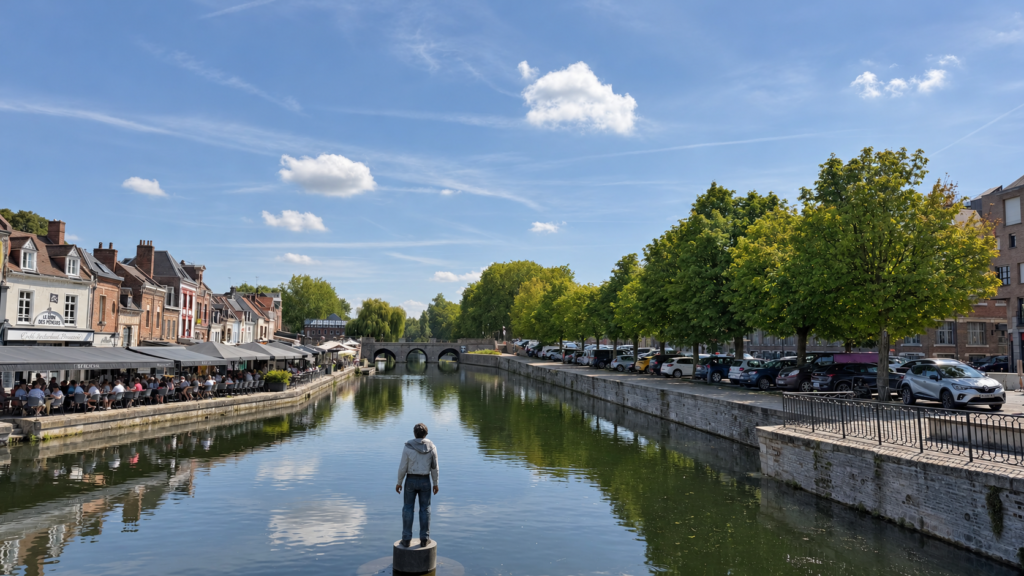
From a distance, the city’s great cathedral dominates the skyline. Down below, life moves at an easier pace. In the Saint-Leu quarter, water passes between narrow, brightly coloured houses, and little bridges join the lanes on either bank. A little further on, the water gardens of the Hortillonnages, with their green islands and narrow canals, blur the line between town and country. Amiens seems to be made of two contrary elements, stone and water, the height of the cathedral and the stillness of the river.
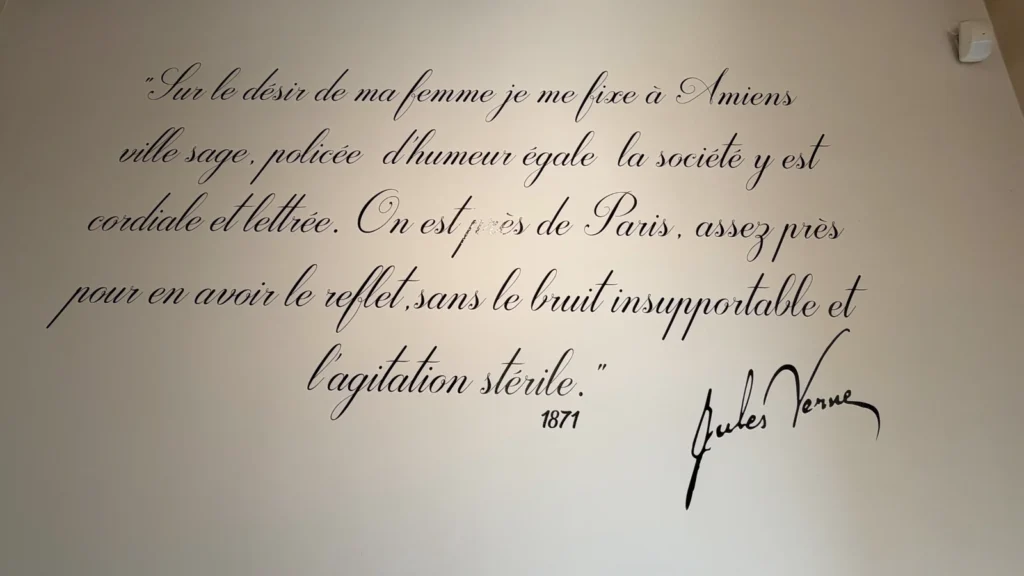
But it wasn’t the sight of the cathedral that brought Amiens into focus for me. It was a sentence I read on a wall in Jules Verne’s house.
“At my wife’s wish, I am settling in Amiens, a quiet, civilised, even-tempered town, whose people are warm and well read. We are close enough to Paris to catch its reflection, without having to endure its intolerable noise and fruitless bustle.”
Jules Verne wrote those words in 1871, when he decided to leave Paris and live in Amiens with his family. At first glance it is a description of a city. The more I think about it, the more it reads like a confidence about choice, love and the meaning of home. He makes no claim to have discovered Amiens or to have chosen the place as a home for his genius. He says, quite simply, “At my wife’s wish.”
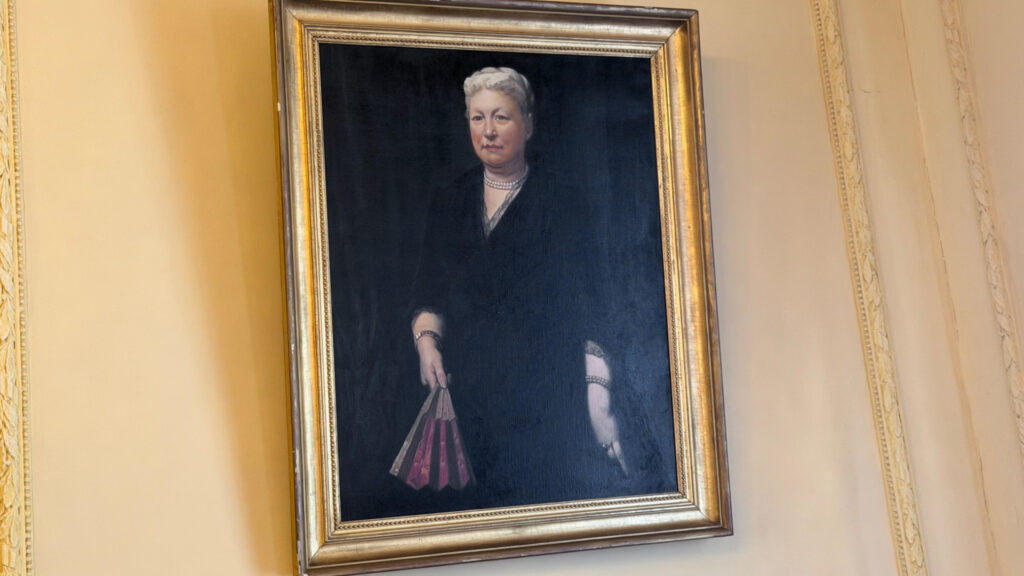
Honorine, Jules Verne’s wife, came from Amiens. They met here at a wedding in 1856 and married a year later. After some years in Paris, the family moved to Amiens to be closer to Honorine’s relatives. From the beginning, then, the story of the house that bears Jules Verne’s name has been bound up with the wishes and the decision of a woman whose name is heard far less often than her husband’s.
History tends to put famous men’s names above the doors of houses. Yet sometimes the direction of a life turns on a decision made by someone whose name is missing from the door. There is no knowing which of Verne’s books would have been written, or left unwritten, had Honorine not insisted on coming to Amiens. What we can see is that the city she chose became the centre of his most productive years.
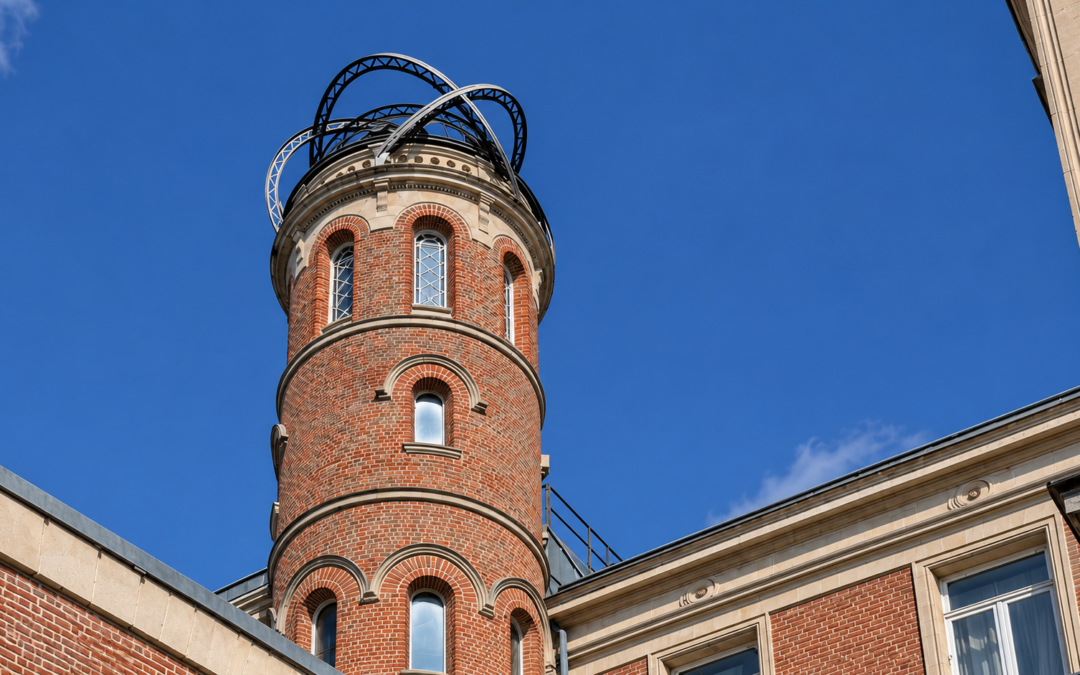
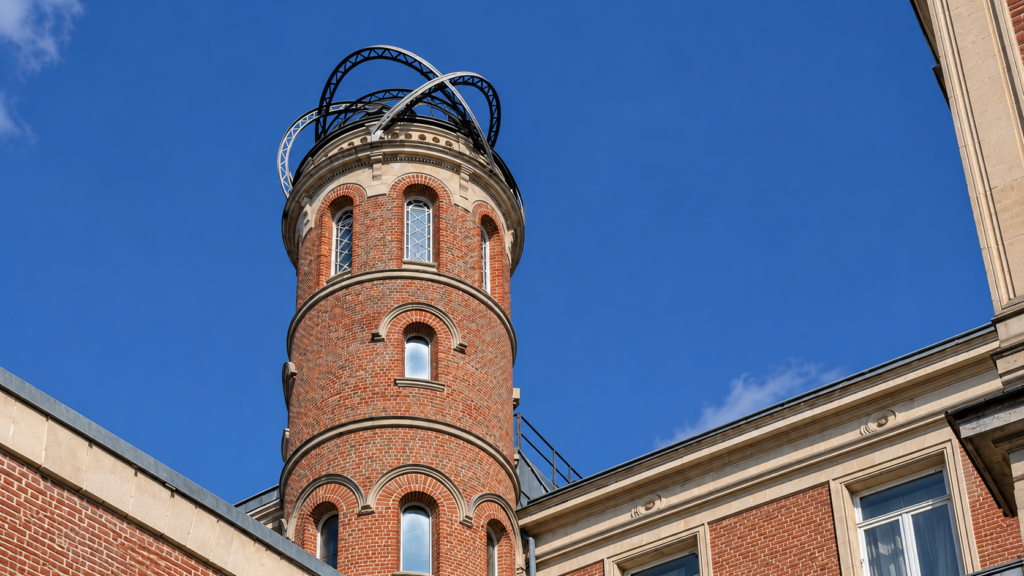
In 1882, when Verne was fifty-four and at the height of his fame, he and Honorine rented the house with the tower on rue Charles-Dubois. They lived here until 1900. It was a large mid-nineteenth-century town house with two upper floors, a spacious attic, reception rooms, a stable and a tower with a view over the city. Many of Verne’s best-known books had already appeared by the time he moved in. His youthful dreams had begun elsewhere. This was the house of his maturity, of the persistence and discipline of a man who had to keep his imagination alive long after his first successes.
Seen from the street, the house might have belonged to any prosperous nineteenth-century town family. Verne’s imagination takes a while to reveal itself. You have to go inside and pass through the winter garden. Light pours in through its glass roof and walls. Its tropical plants, ironwork and ornaments recall the fascination that distant lands held for people of the time. When the family lived here, this was the main entrance to the house.
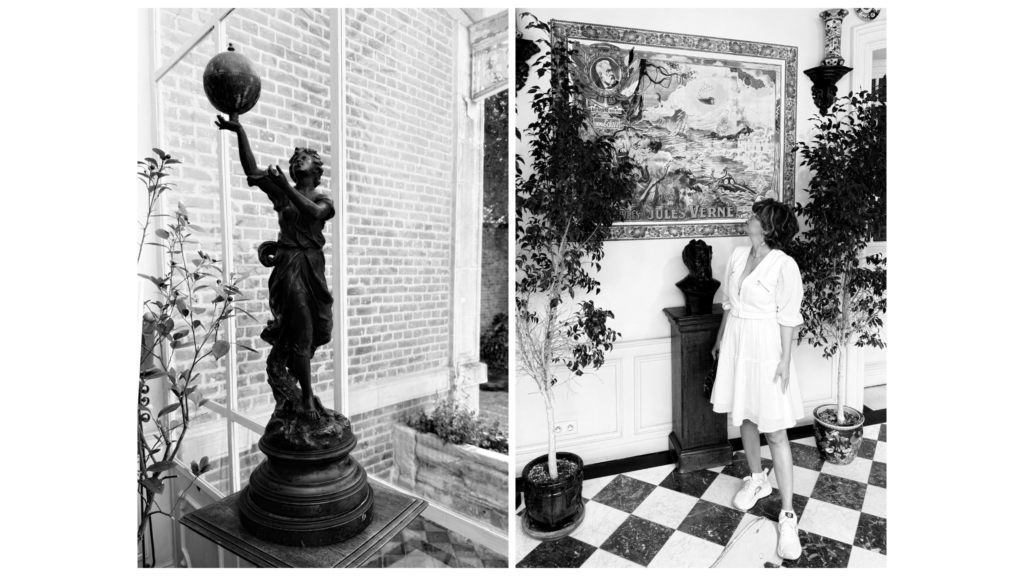
Among the plants stands a statue of a woman holding a globe aloft. On its base you can make out the word “world”. I don’t know exactly what the artist had in mind. But for me that woman became the house’s central image. She holds the world in her hands, in the home of a man who made his name taking his readers around it.
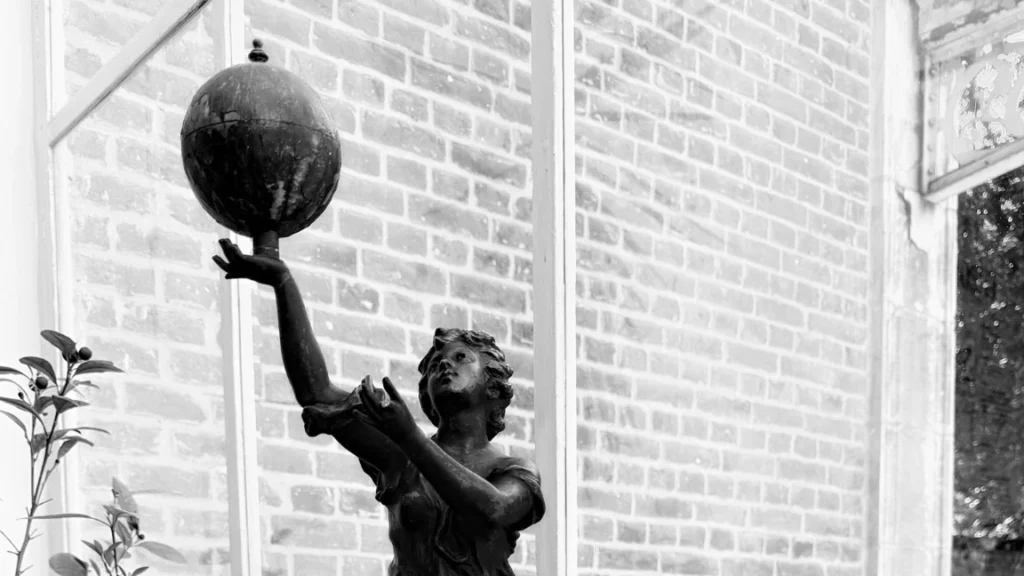
Perhaps it was only a visual coincidence. In my memory it came to mean something else. The world we so readily credit to a writer, an artist or a great man has often rested in other hands as well. They belonged to the people who provided a home, time, quiet and the chance to work.
The ground floor still feels more like a lived-in house than any other part of the building. The Gothic Revival dining room, with its heavy furniture, coffered ceiling and china bearing Jules Verne’s personal monogram, was used only on special occasions. In the adjoining drawing rooms and smaller rooms, family photographs and everyday objects give the place a more human presence than a museum display case usually conveys. The dining room is the only part of the house whose original décor survives almost in its entirety.
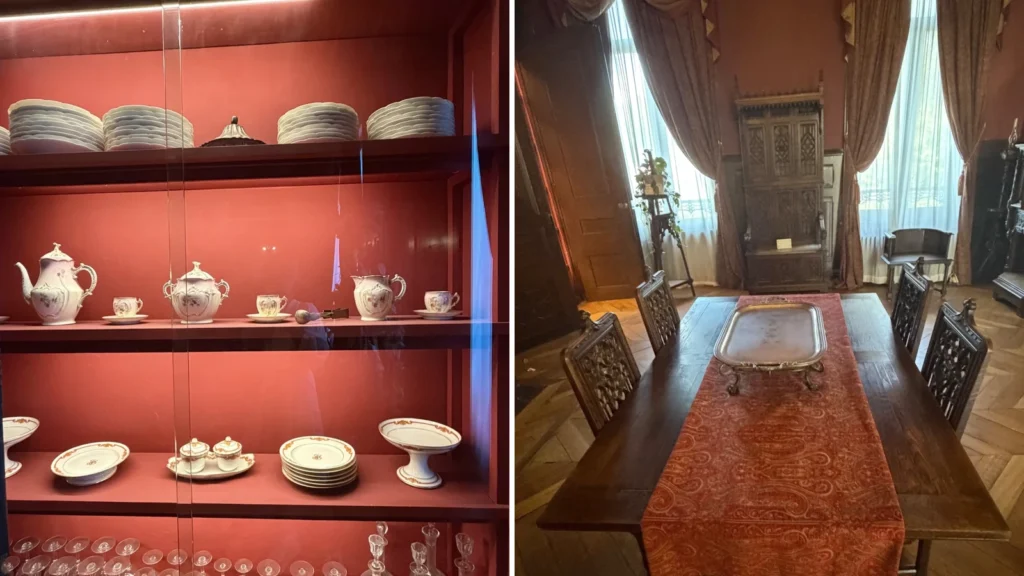
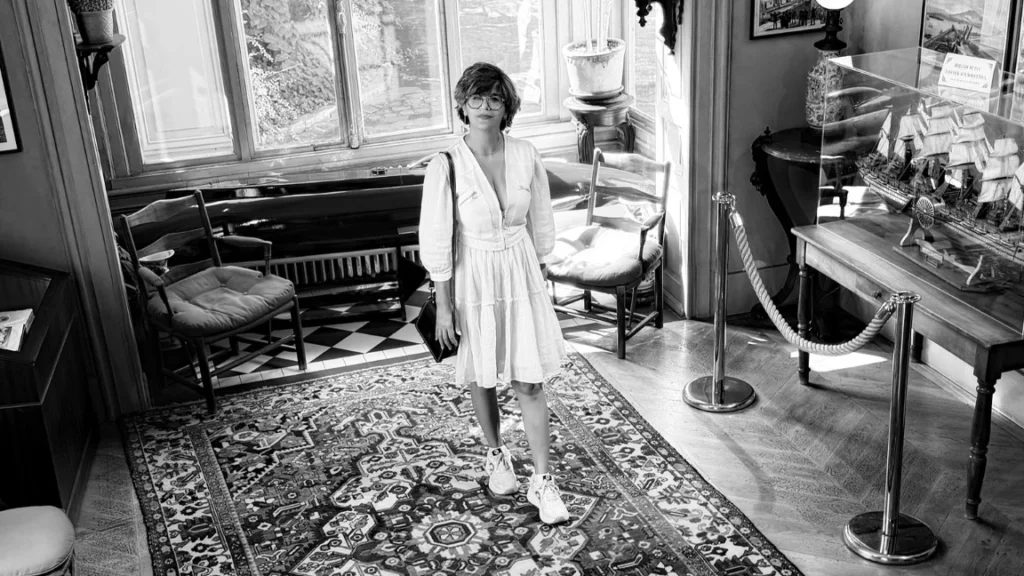
A Persian rug, with its red field and deep blue borders, gave me something familiar to hold on to in these rooms. I recognised something of Iran in its patterns, as though a part of the culture of my own country had reached this place before me.
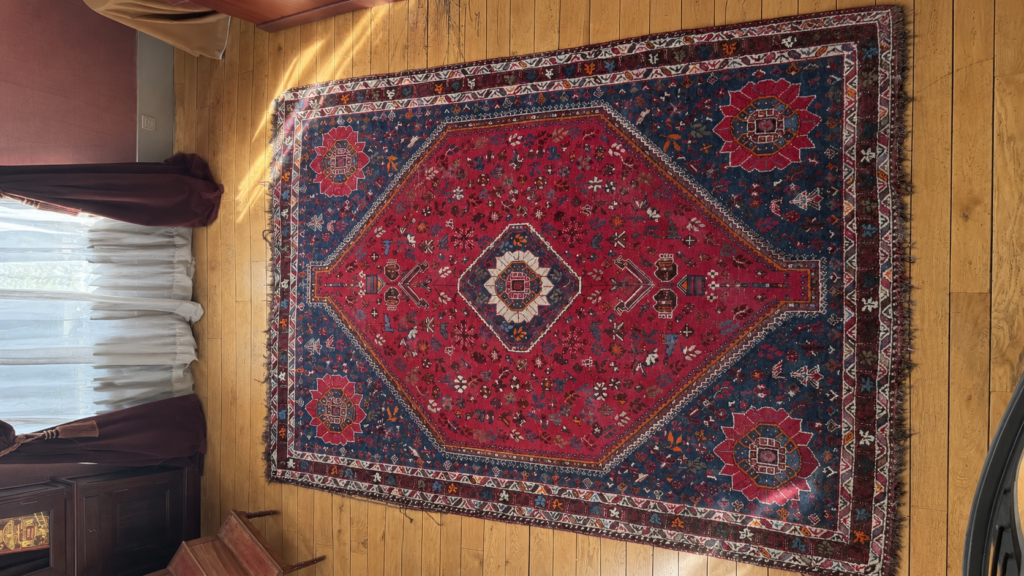
In the small drawing room, which served as the smoking room, the walls are covered in cashmere patterns. To an Iranian eye, those shapes have an instantly recognisable name, boteh jegheh, the Persian paisley. For a moment the distance narrows between a house in northern France and the memory of Eastern fabrics and patterns. Sometimes culture travels ahead of us. Motifs, words and stories find their way into other people’s lives before we ourselves arrive.
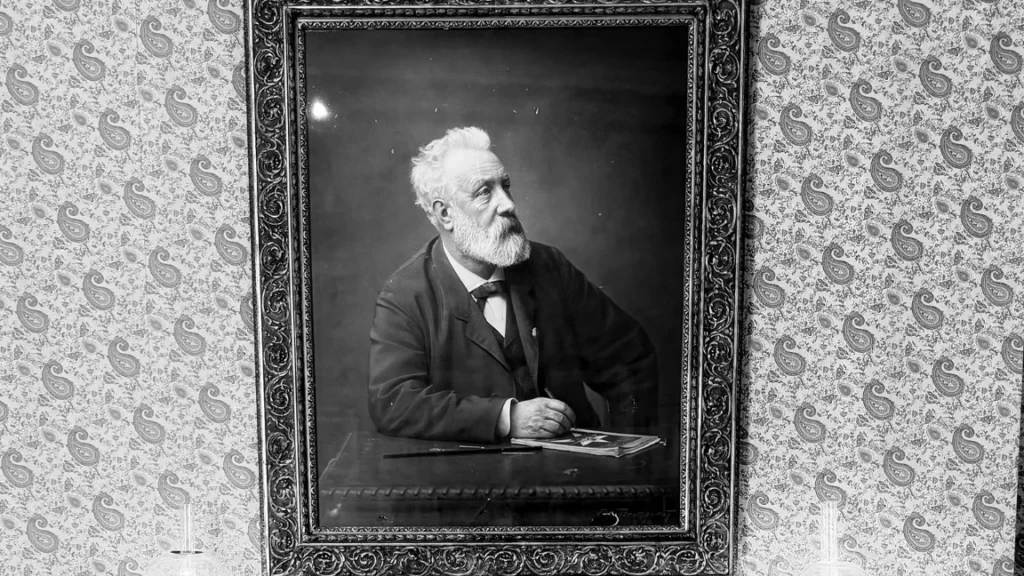
A panel explains that Jules Verne entertained his male guests here with liqueurs and cigars. Without intending to, that short sentence also records something of the relations between men and women in nineteenth-century bourgeois households. Here was a room set aside for men to talk and keep company, in a house whose daily life, and whose very location, are hard to imagine without Honorine. The house has as much to say about the customs of Verne’s time, social class, the division of space and the relationships people formed as it does about one writer’s genius.
Among all the maps, ships and books, a framed piece of paper also stopped me. It was Jules Verne’s law degree.
His father wanted him to follow him into the legal profession. In 1848 the young Jules went to Paris to study law and completed his studies. Yet literature, theatre, geography and distant worlds occupied his mind far more than courtrooms or lawyers’ offices. Even that choice involved no sudden, heroic break. He worked on the stock exchange for a time to support his family and gave up the job only when he could make a living from his writing.
To me, that degree was a record of a life he had never lived.
Each of us carries several unlived lives. A profession we never chose, a city we didn’t stay in, a love we didn’t pursue, or a dream for which we dared to change course. Verne’s unlived life is still here in his house, behind glass, in the shape of a university degree. He could have been a lawyer, perhaps a successful and respected one. But then there might have been no one to take us to the centre of the Earth, to the depths of the sea, or around the world with Phileas Fogg.
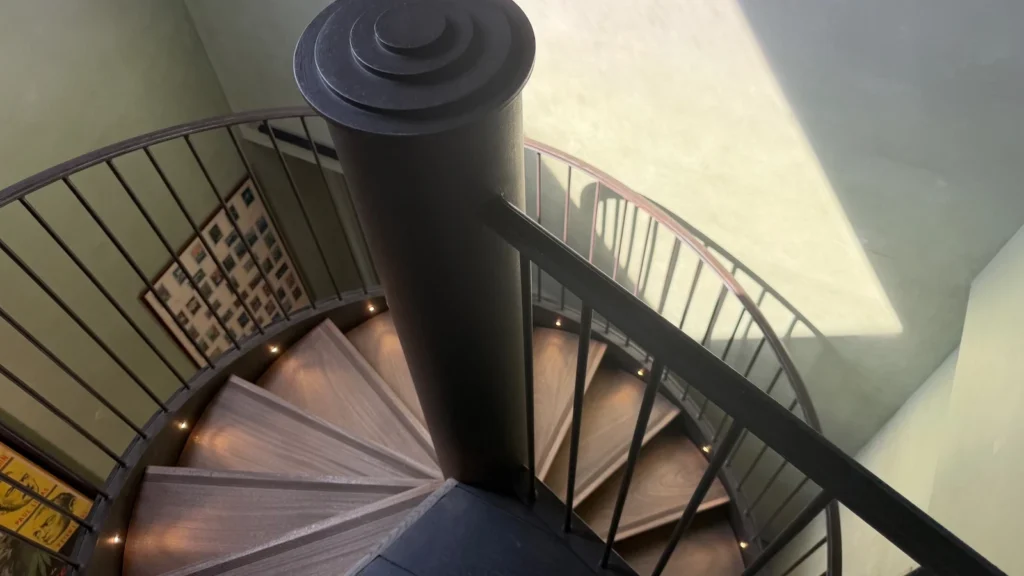
As we climb the stairs, the family rooms give way to the writer’s world. On the second floor were his library and study. His library held some twelve thousand volumes. Alongside the classics and works by writers such as Homer, Montaigne, Shakespeare, Dickens and Edgar Allan Poe were books on geography, encyclopaedias, newspapers and scientific journals. He regularly took notes as he read and filed them by subject.
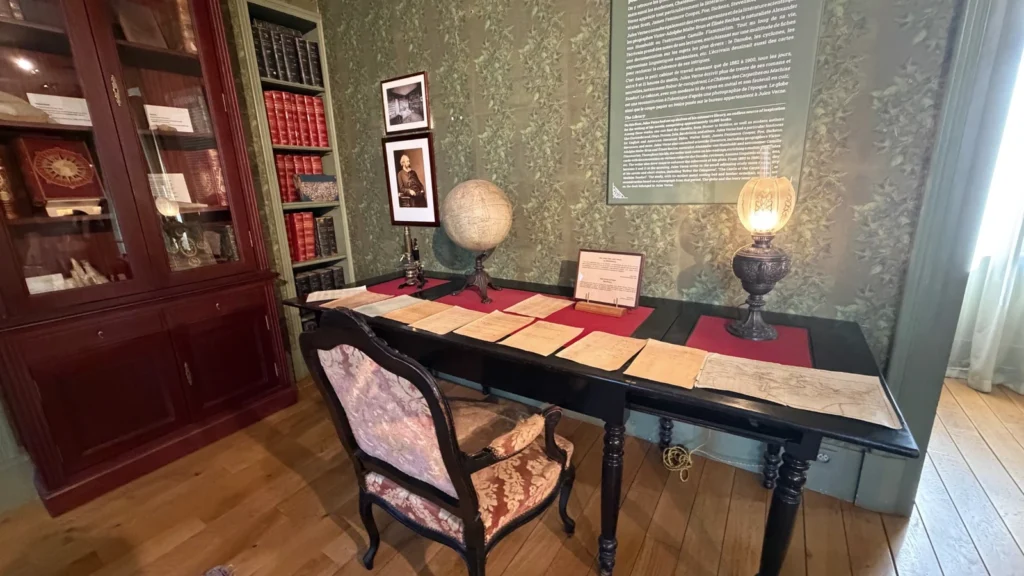
It is in the study, though, that you come upon the house’s most striking paradox. The largest worlds took shape in its smallest room.
Verne usually wrote here from five in the morning until eleven. A desk, a leather chair, a metal daybed and a globe hardly make for a grand interior. It is a small, unassuming room. Yet during the years he lived in this house he wrote more than thirty novels and stories.
In a room like this, imagination no longer looks like a spark from heaven. It looks more like discipline. Getting up early, reading for hours, taking notes, sorting them, and coming back the next day to sit at the same desk.
We tend to tell the story of genius as if it were a mysterious gift that reveals itself all at once, perhaps because that makes a more appealing story. Verne’s study suggests a simpler, more demanding truth. Even to travel to the least-known places in the world, you have to sit down in the same spot every day.
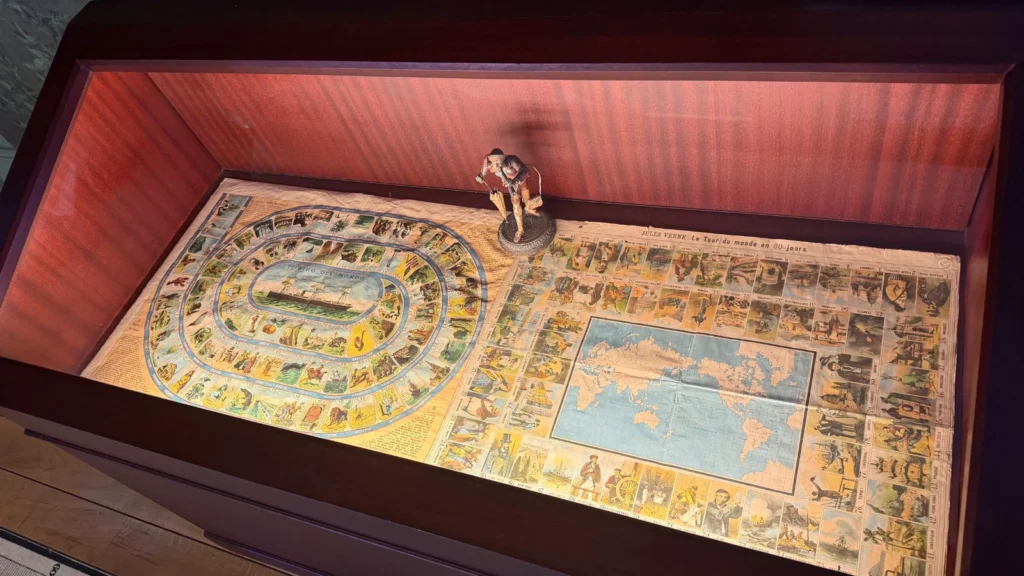
Part of the house is devoted to his publisher, Pierre-Jules Hetzel. Hetzel’s office and drawing room have been recreated, and fine editions of the books, letters and documents from their years of working together are on display. That curatorial choice matters. It reminds us that even a writer who sits alone at a desk does not make a book entirely alone. Editors, publishers, illustrators, translators, families and readers all have a hand in bringing a book into the world and keeping it alive. Verne’s collaboration with the Hetzel family lasted more than four decades.
I stopped beside the Persian translation of Around the World in Eighty Days, a book I had read in Iran. Now its Persian title was in front of me in the author’s own house, and an acquaintance made long ago was picking up again here. Long before I reached Amiens, Jules Verne had entered my life in translation.
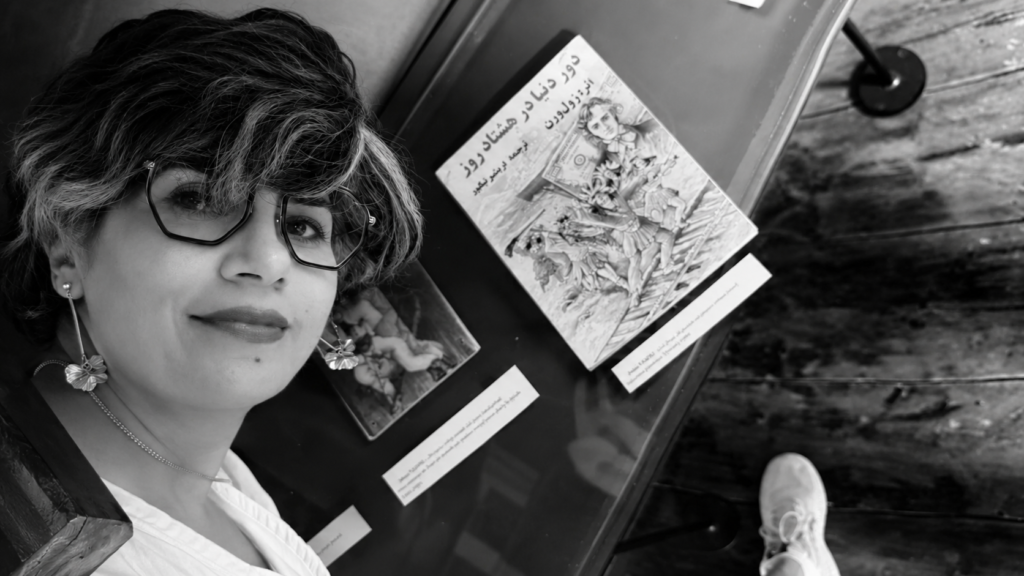
Seeing the book also made me aware of what that early acquaintance owed to translators. Verne himself read in translation. In an interview Robert Sherard published in 1894, he said that was how he read Dickens. Translation had brought him closer to another writer, just as it would one day bring his own stories to me in Iran.
On one wall are the words Hetzel used in 1866 to describe Jules Verne, “a storyteller full of imagination and at the same time deeply learned”. Here was a writer who had created a new genre and delivered what so many promise and so few achieve, “instruction that entertains”. That may be the most precise account of Verne’s power. He never turned science into a sermon. He put it inside the adventure, letting readers grow curious about the Earth, the sea, technology and the unknown without ever feeling they were sitting in a classroom.
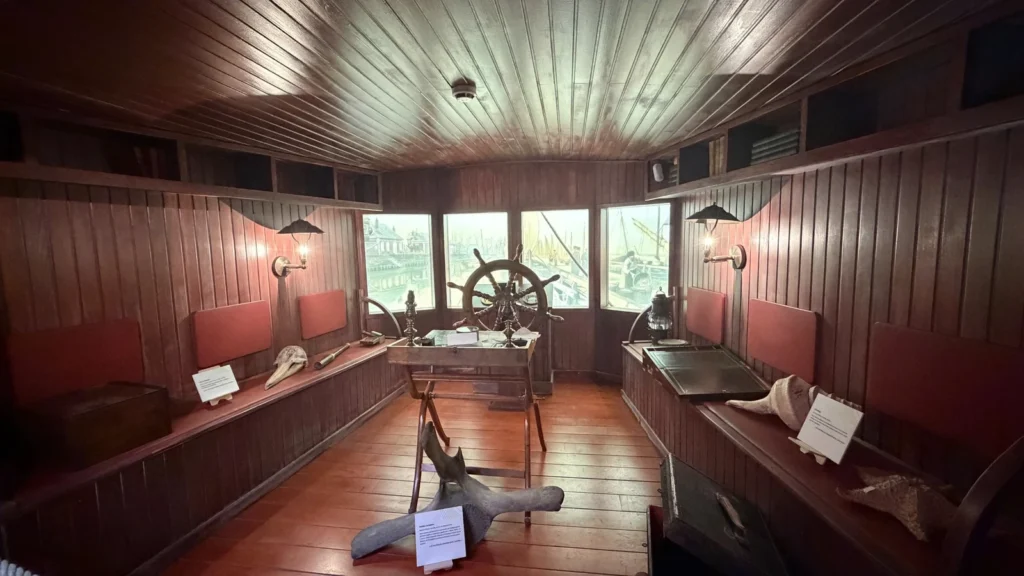
His travels extended well beyond the library. He went to Scotland, England and Scandinavia. With his brother he crossed the Atlantic on the immense Great Eastern and saw New York and Niagara Falls. He gave his own boats the name Saint-Michel and took notes while at sea. Real journeys were no end in themselves for him. They were the raw material his imagination transformed into far more distant territories.
As I made my way through the rooms, I found myself travelling with Jules Verne again in my imagination. Among the models and maps, the books of his I had read came back to me, and the visit became a continuation of those journeys.
In Twenty Thousand Leagues Under the Seas, Captain Nemo seeks his independence by cutting himself off from human society. The commander of the Nautilus tells Professor Aronnax, “I have broken with all of society for reasons that I alone have the right to judge.”
For Nemo the sea is a refuge from the powers that rule on land, a realm in whose depths, he believes, the reign of despots comes to an end. This is how he describes it.
“The sea does not belong to despots. On its surface they can still exercise their unjust rights, fight one another, tear one another apart and carry there all the horrors of the land. But thirty feet below its surface, their power ends, their influence dies out and their authority vanishes!”
Captain Nemo in Jules Verne’s Twenty Thousand Leagues Under the Seas, Part One, Chapter Ten.
And yet what is most human about his life in Amiens may be the fact that, for all his travels, he stayed.
On another wall are a few words from 1888.
“My sole intention is to be of use and to help bring about certain reforms in the city.”
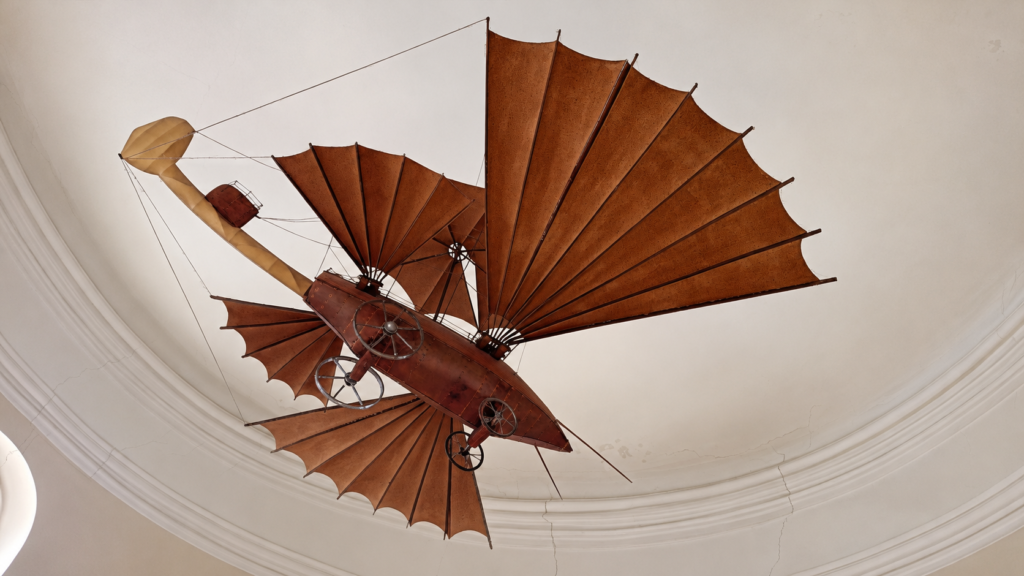
For sixteen years, from 1888 to 1904, Verne served on Amiens city council. He took part in the city’s cultural and civic affairs, speaking on the lighting and heating of public spaces, the theatre, transport and urban development. The man who imagined flying machines and extraordinary submarines in his novels had accepted that, in ordinary life, changing the world sometimes begins with apparently small things. A street gets its lighting, a public building its heating, a theatre gets to keep its doors open.
Amiens was more to him than a quiet backdrop for his writing. The city he had first chosen at his wife’s wish gradually became a responsibility he took upon himself. Having made his home there, he came to take part in its public life.
The house museum preserves chiefly the years of achievement and acclaim. A life, though, is never as tidy as a set of reconstructed rooms. In 1886, Verne was wounded in the leg when his nephew shot him. That same year he lost Hetzel, his publisher and close friend. The injury took its toll on his body, and the atmosphere of his later books gradually darkened too. In 1900 he and Honorine left the town house for a smaller home that better suited their needs. Five years later, Jules Verne died in Amiens.
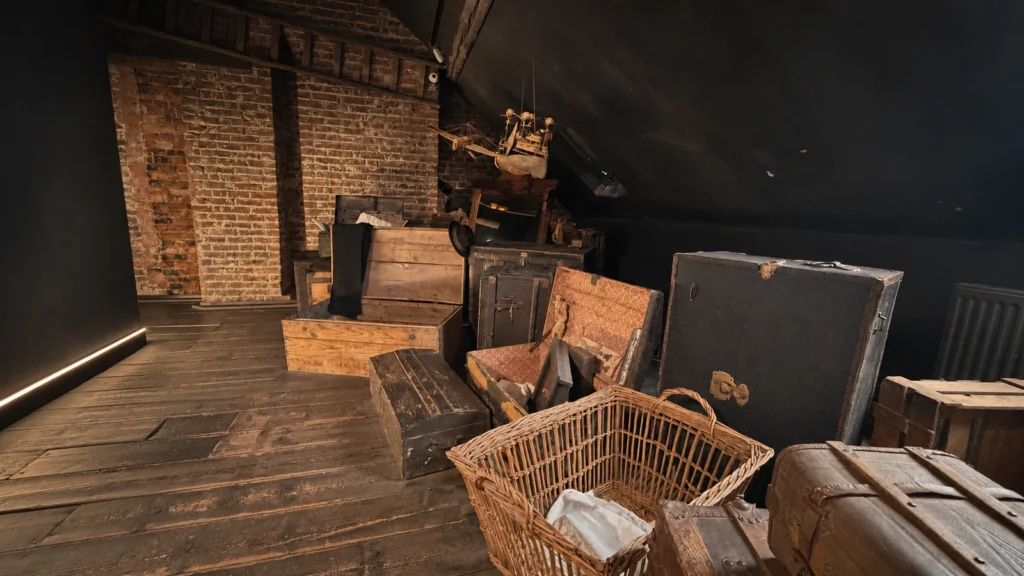
Museums tend to keep the people who once lived in these houses in their finest room, at the most glorious moment of their lives. No one stays at that height forever. Behind Verne’s worldwide fame was a man who lived with his father’s expectations, the demands of a family, the difficulty of earning a living, injury, the deaths of friends, old age and the limits of everyday life. Perhaps that is why his little study leaves a deeper impression than all the imaginary machines in the museum.
On my way out, I passed the statue again, the woman holding the world aloft. Outside, Amiens was as quiet as ever. Water ran through the city, the cathedral stood above the rooftops, and the city made no effort to seem grander than it was.
I thought that perhaps what Amiens had given Jules Verne was everything that makes inspiration possible, rather than a sudden flash of it. Just the right distance from the clamour of Paris, family close by, a house in which to work, a city whose life he could share, and mornings when he could sit at his desk in silence.
Travelling need not always mean leaving. Sometimes a journey begins at the moment you choose somewhere to stay. Some cities we inherit by being born there. Others we choose partway through our lives, and in the years we spend in them, we come to belong.
Amiens was not Jules Verne’s birthplace. It became the city of his maturity, his work and his fame, of his life as a citizen, his old age and his death. From a small room in a quiet city he sent millions of readers around the world.
Perhaps to travel around the world, you must first find somewhere you can stay.